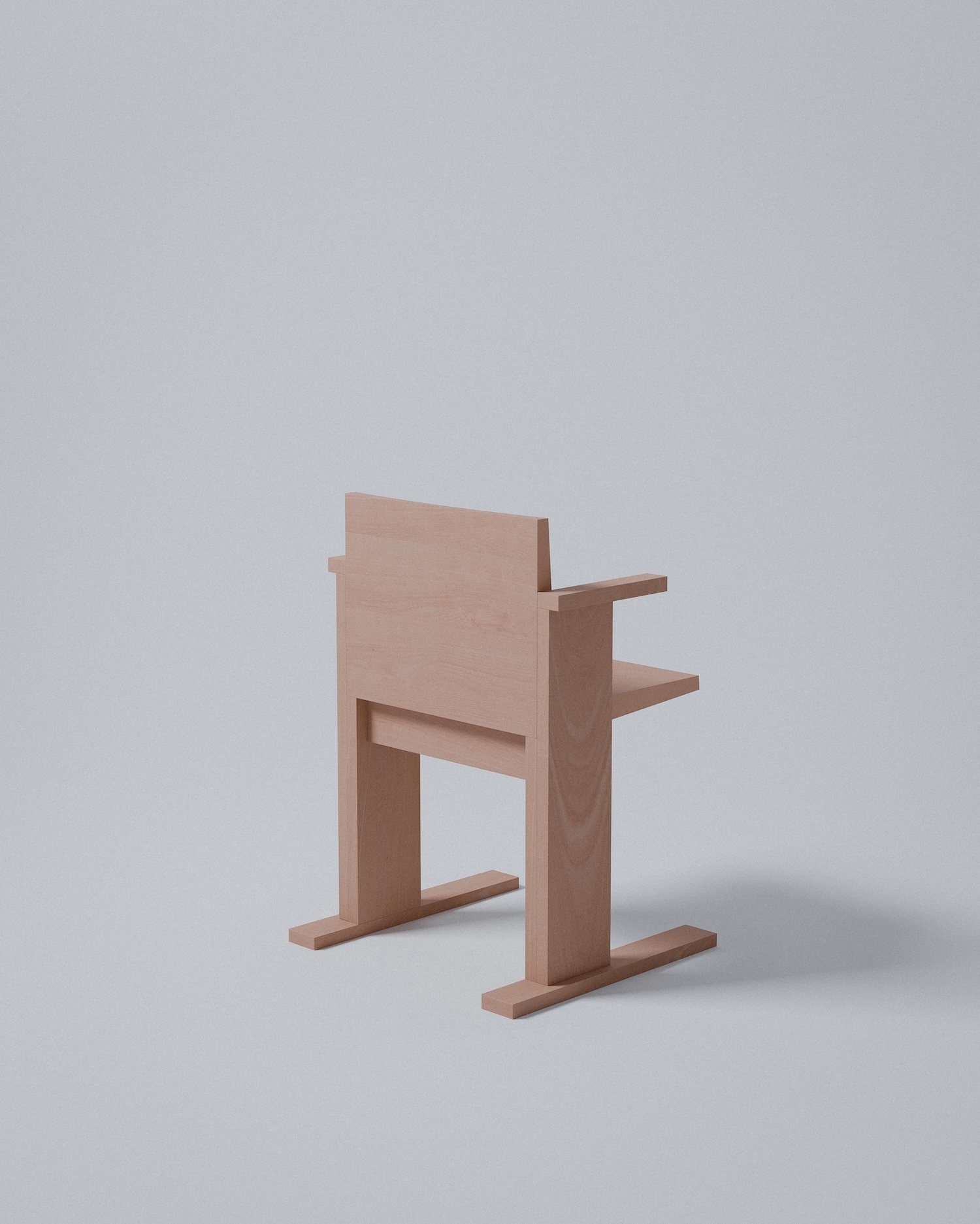
AC–1 is a minimalist chair created by Mexico-based designer Sergio Enríquez. The cantilever chair carries weight beyond its physical form. Since Marcel Breuer’s revolutionary Wassily chair of 1925, designers have wrestled with this floating gesture – that death-defying leap where seat appears to hover without rear support. Each iteration tells a story of its era’s materials and manufacturing capabilities: Breuer’s chrome and leather spoke to industrial optimism, while Mart Stam’s tubular steel variants embodied functionalist ideals. The AC-1 enters this lineage not through imitation but through fundamental reimagining.
Where predecessors relied on metal’s tensile strength or complex joinery, this design proposes something altogether different. The chair’s maker explains: “AC-1 emerged from a place of curiosity – an attempt to push the boundaries of a typology that has always intrigued me. It is a study in structure, texture, and touch – qualities that often go unnoticed in everyday furniture.” This curiosity manifests in an elegant structural solution that feels both inevitable and surprising.
The beech wood itself becomes protagonist in this narrative. Unlike the industrial materials that dominated cantilever history, solid timber brings warmth and grain variation that no two pieces can replicate exactly. Each chair carries the unique signature of its source tree – growth rings that record seasons, subtle color variations that speak to soil conditions and sunlight exposure. The hand-milling process preserves these individual characteristics while achieving the precise geometry the design demands.
“The design is built from two main structural elements, joined at the base of the legs,” the designer notes. “This creates a surprising yet logical resolution to a structural challenge, making the form feel intuitive and grounded.” This junction point becomes the design’s crucial innovation – where engineering necessity transforms into aesthetic opportunity. The joining method distributes weight and stress in ways that allow the cantilever effect while maintaining structural integrity throughout scaling variations.