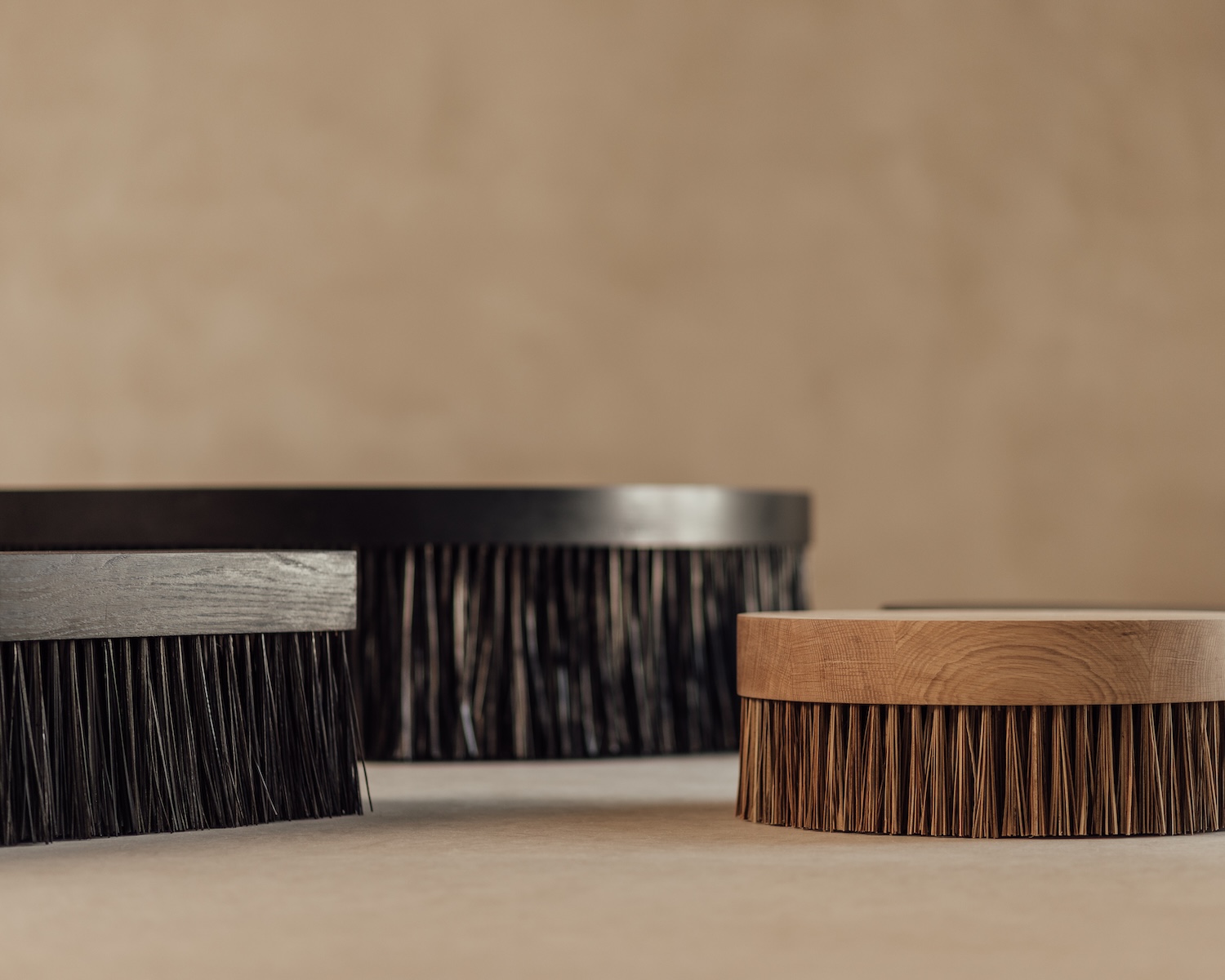
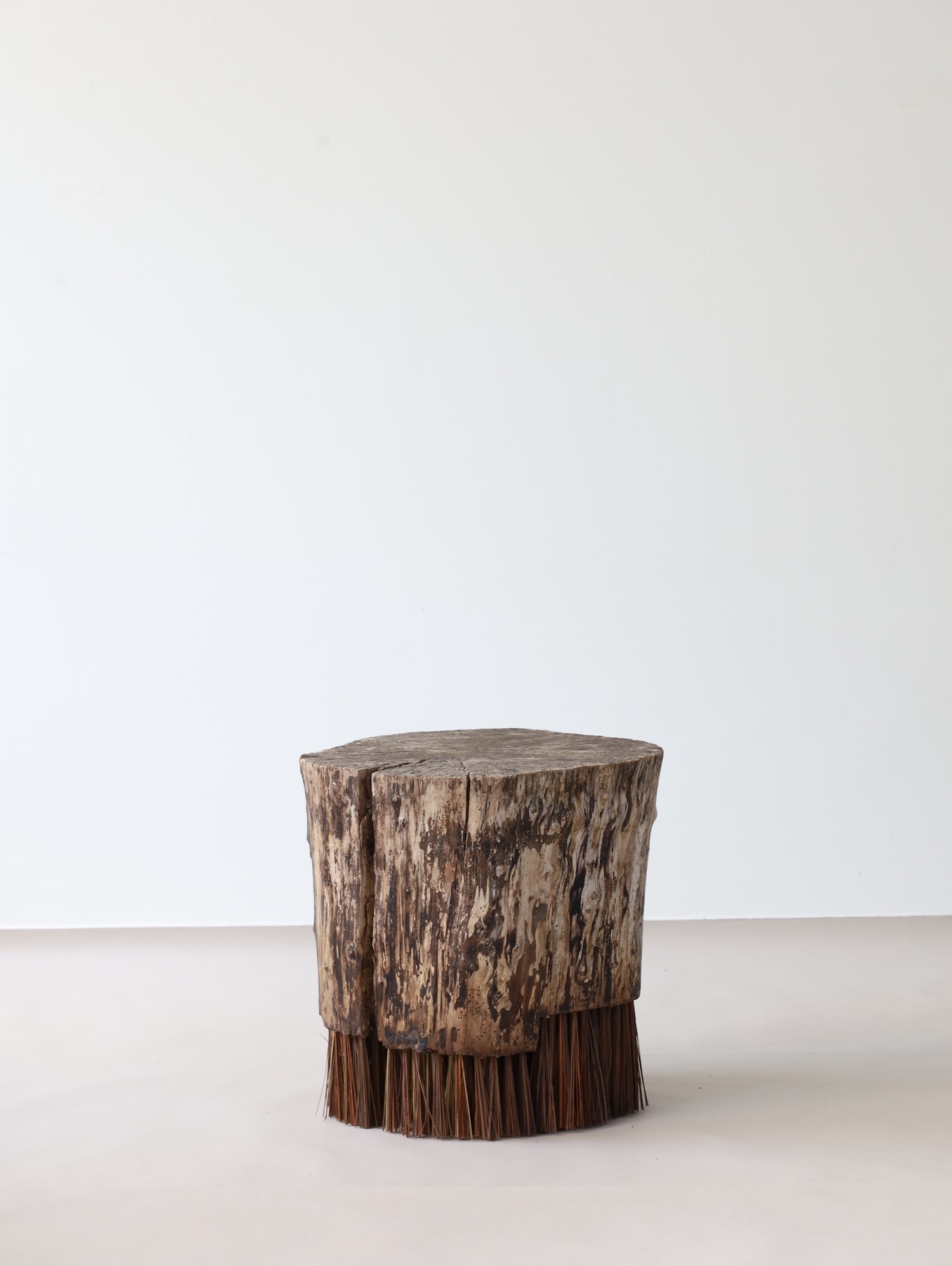
The Bristle Collection is a minimalist furniture collection created by Houthalen-based designer Linde Hermans, built around an object that passes through the hands daily and almost never registers as design at all. Stripped of its handle and inflated to the scale of a bench or a coffee table, the brush stops behaving like an instrument and becomes a body. The bristles that once cleared a floor now carry weight, and the tool quietly changes sides.
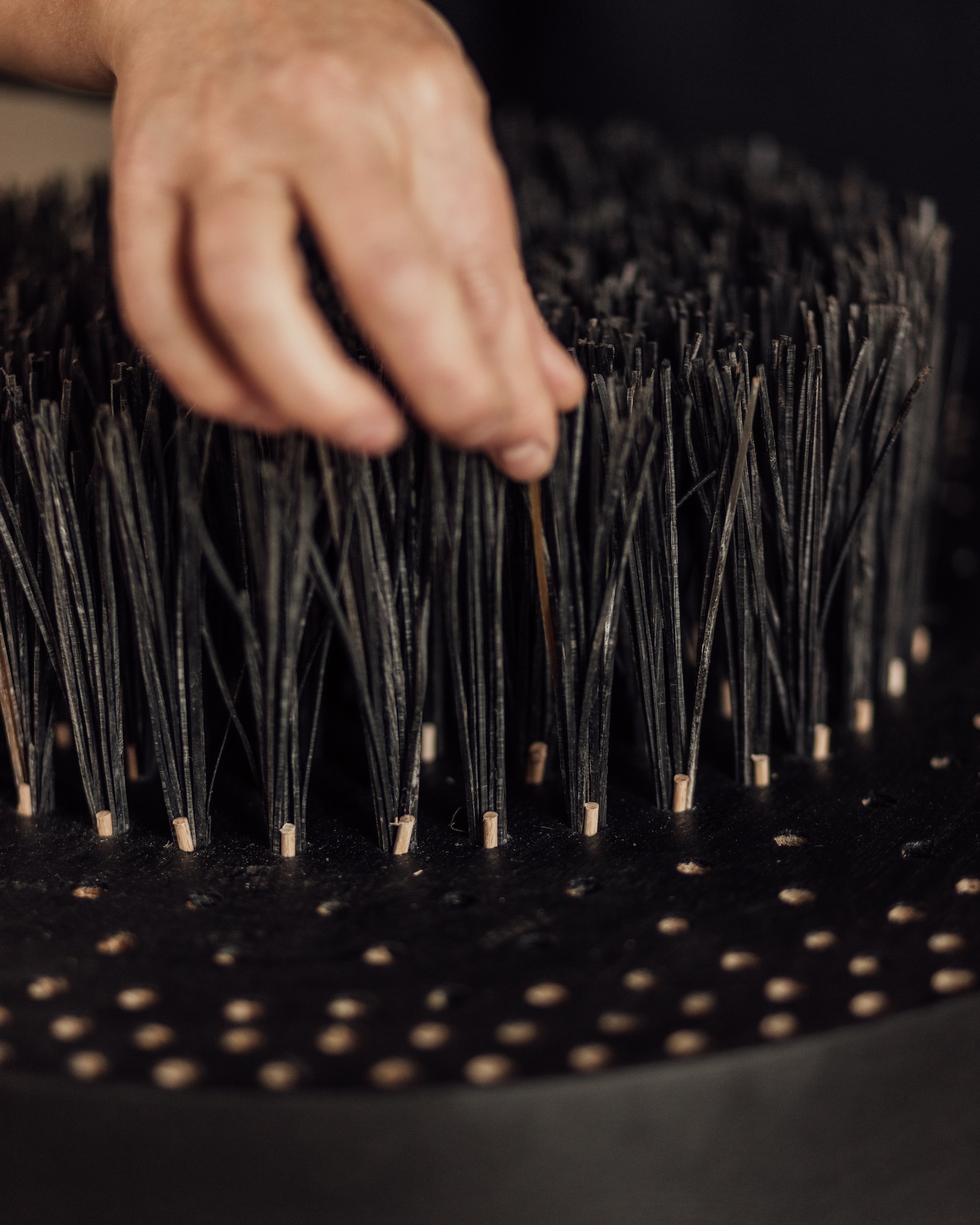
Construction follows brush-making orthodoxy rather than furniture orthodoxy. A solid disc or bar of black-stained oak is drilled with a dense field of holes, and each tuft of fiber is folded, seated, and locked with a small wooden wedge driven in behind it. The underside reads as a constellation of pale plugs against dark grain, the visible record of several thousand individual decisions. This is the hand-wedged method that predates staple-set machine production and pitch-filled trepanning, and it survives now mostly in restoration workshops and a handful of European ateliers. Hermans has not borrowed the look of a brush. She has borrowed the labor.
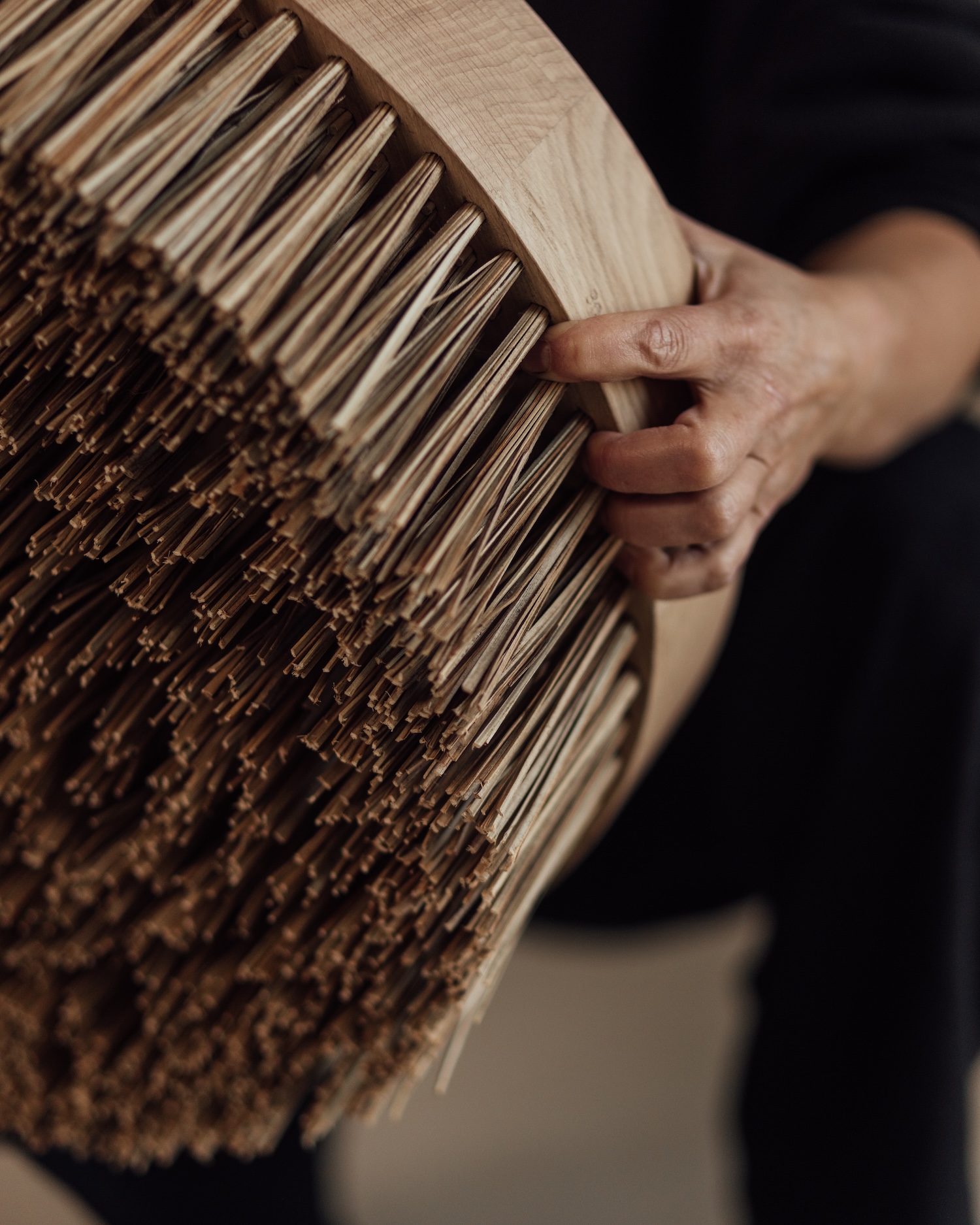
Reed stalks and the coarse fibers drawn from palm leaves and stems supply the pile, materials that sit in the same family as piassava and arenga, the tough dark bristles that have swept factory floors and ship decks for well over a century. Reed reads lighter and more brittle, splitting into flat ribbons that catch light along their length. Palm fiber holds a deeper black shot through with copper strands, which is why the natural oak version looks almost thatched while the stained versions dissolve into shadow at the floor line. Neither fiber is strong on its own. Bundled under compression and held in tension by the wedge, they become a load-bearing plinth, a structural argument made entirely out of things that snap between two fingers.
Two limited-edition pieces use baleen recovered from old stock, the keratin plates that filter feed from seawater in the mouths of whales. Before synthetic polymers arrived, baleen was the flexible material of choice for corset stays, umbrella ribs, carriage springs, and brush fiber, and its exhaustion is inseparable from the industrial hunting that nearly emptied the oceans. Working with a surviving stock rather than a substitute turns the object into a document, and a portion of the proceeds goes to Sea Shepherd. The gesture is restrained enough to avoid moralizing, which is what allows it to land.