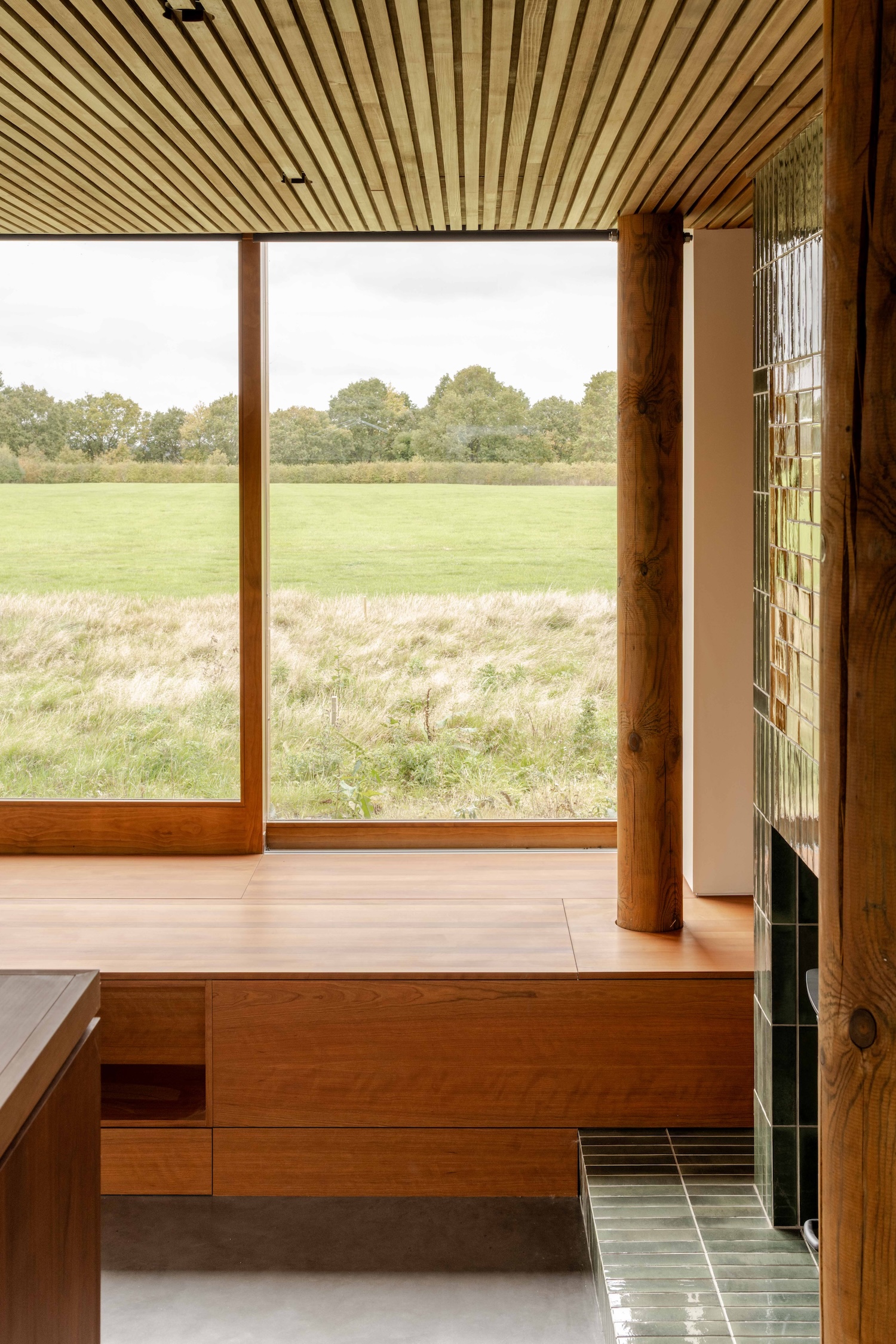
Cedar Barn is a minimalist residential conversion located in East Anglia, United Kingdom, designed by Fieldwork Architects. The project’s central tension – between enclosure and exposure, between the agricultural past and contemporary domestic life – finds its resolution in an organizing idea borrowed from optical equipment. The periscope concept, in which key spaces are elevated above the treeline to capture wider views of the surrounding countryside, determines nearly every decision in the building’s spatial sequence. It is a move that ties sight lines directly to program, making the act of looking outward a structural condition rather than an incidental amenity.
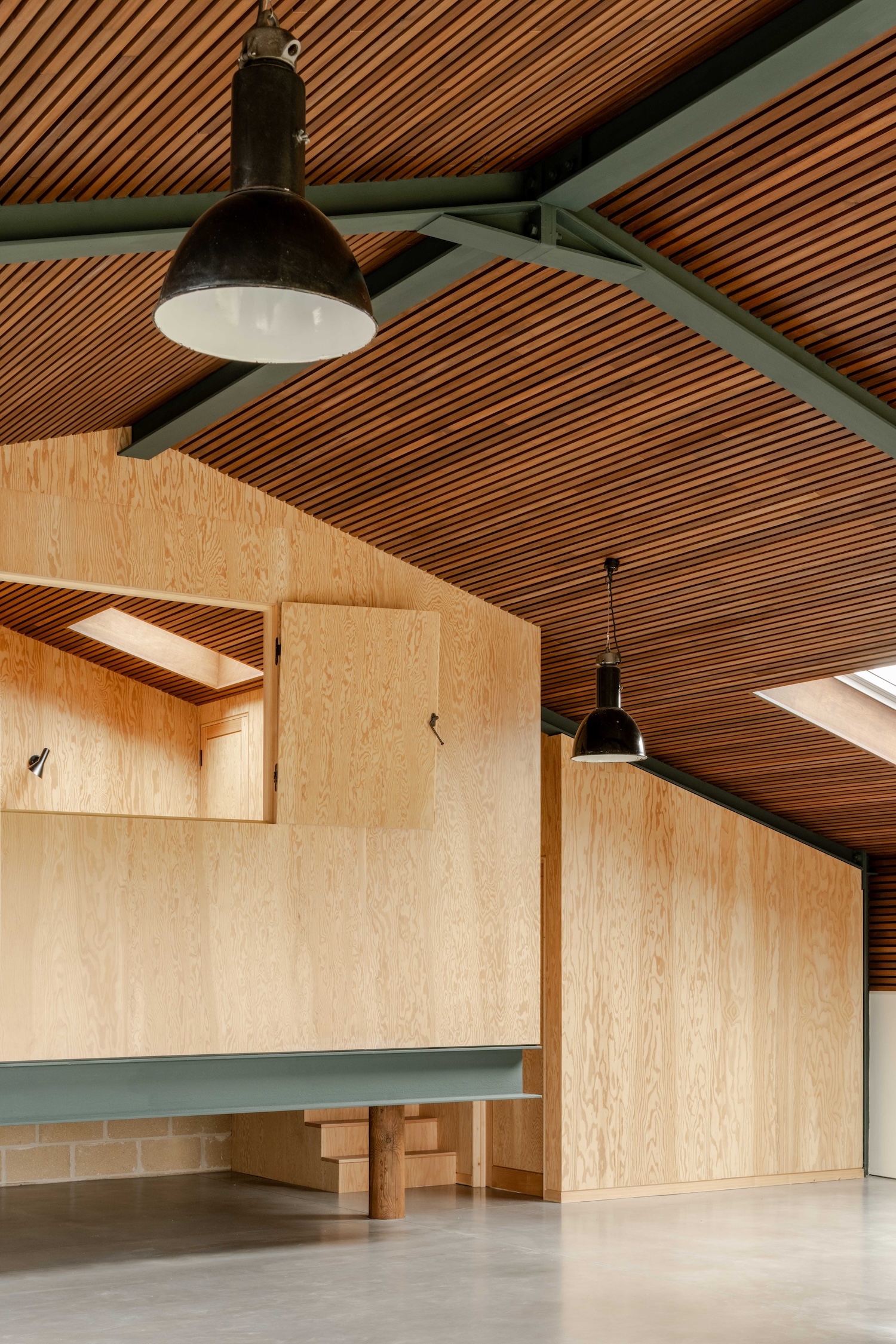
The 280-square-metre project is arranged as two distinct barn volumes connected by a lightweight timber colonnade – a covered threshold that allows both buildings to function independently or as a unified whole. The front barn carries the elevated cedar-clad volume that captures landscape views, while beneath it, a sunken conversation pit and sauna establish the counterpoint: a more compressed, inward-looking space that reads as a deliberate retreat from the panorama above. The rear barn develops this logic further, housing three timber volumes within an open plan arrangement, with the central element lifted to overlook the interior below. These inserted boxes define zones without resorting to conventional partition walls, maintaining the spatial generosity of the original agricultural shell.
Exposed primary steel and polished concrete floors hold the structural and agrarian register, while cedar, Douglas fir ply, and cork introduce warmth in layers rather than as a wholesale softening gesture. The Douglas fir extends from structural posts through to bespoke joinery and internal linings, natural finishes left to reveal the grain rather than suppress it. Cork appears as inset flooring within the boxes, cushioning the thresholds and steps – a material deployed at the scale of the body rather than the room, which is where its presence is most felt.