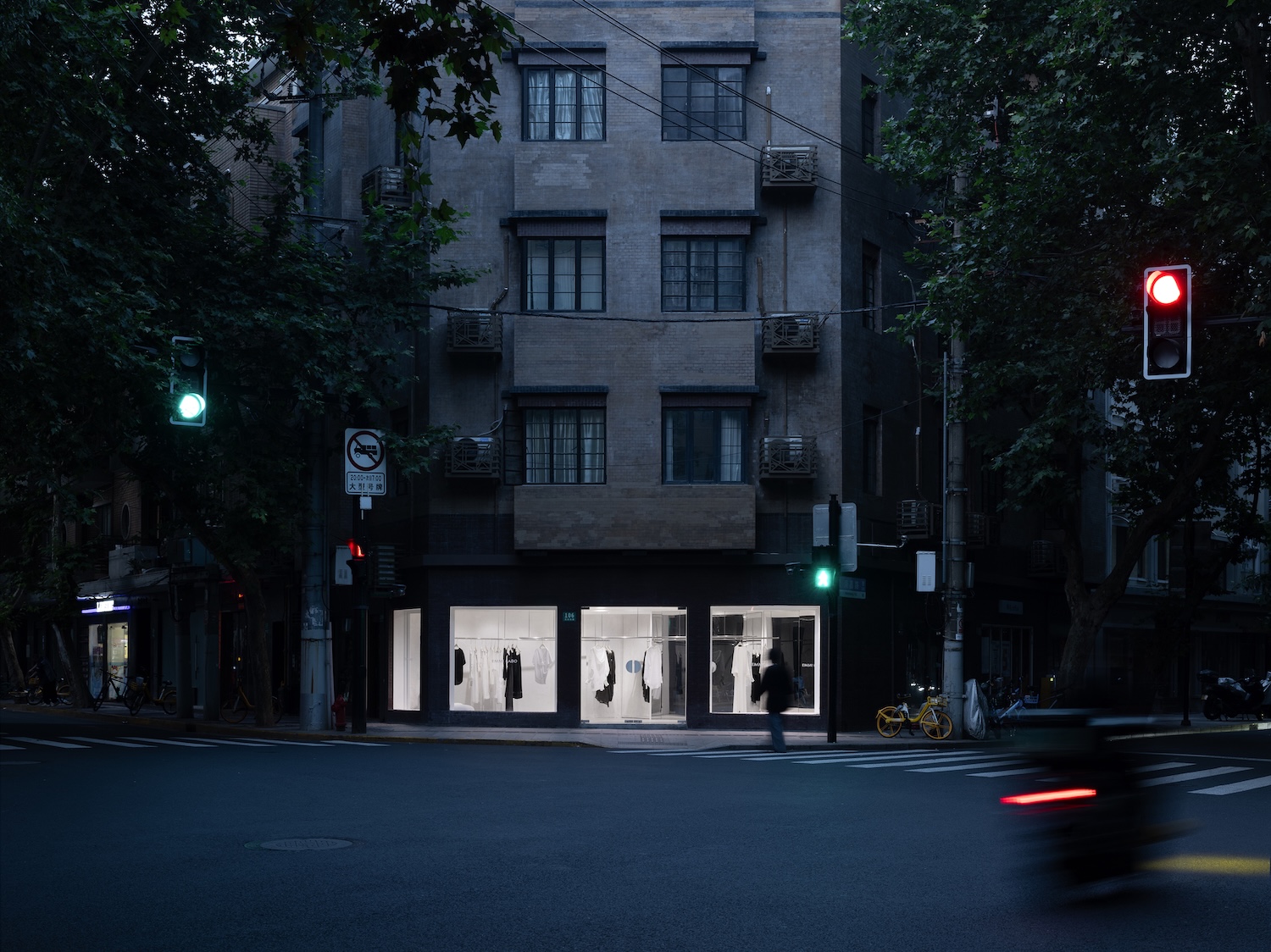
EMMI LABO is a minimalist retail interior located in Shanghai, China, designed by ATELIER YÙN. At just 45 square meters, the project confronts one of retail design’s most persistent tensions – how to make a small space feel generous without sacrificing the operational machinery a store actually needs. Atelier Yùn’s answer is not to hide the constraint but to let it drive every decision, producing a shop where architectural discipline and visual openness become indistinguishable.
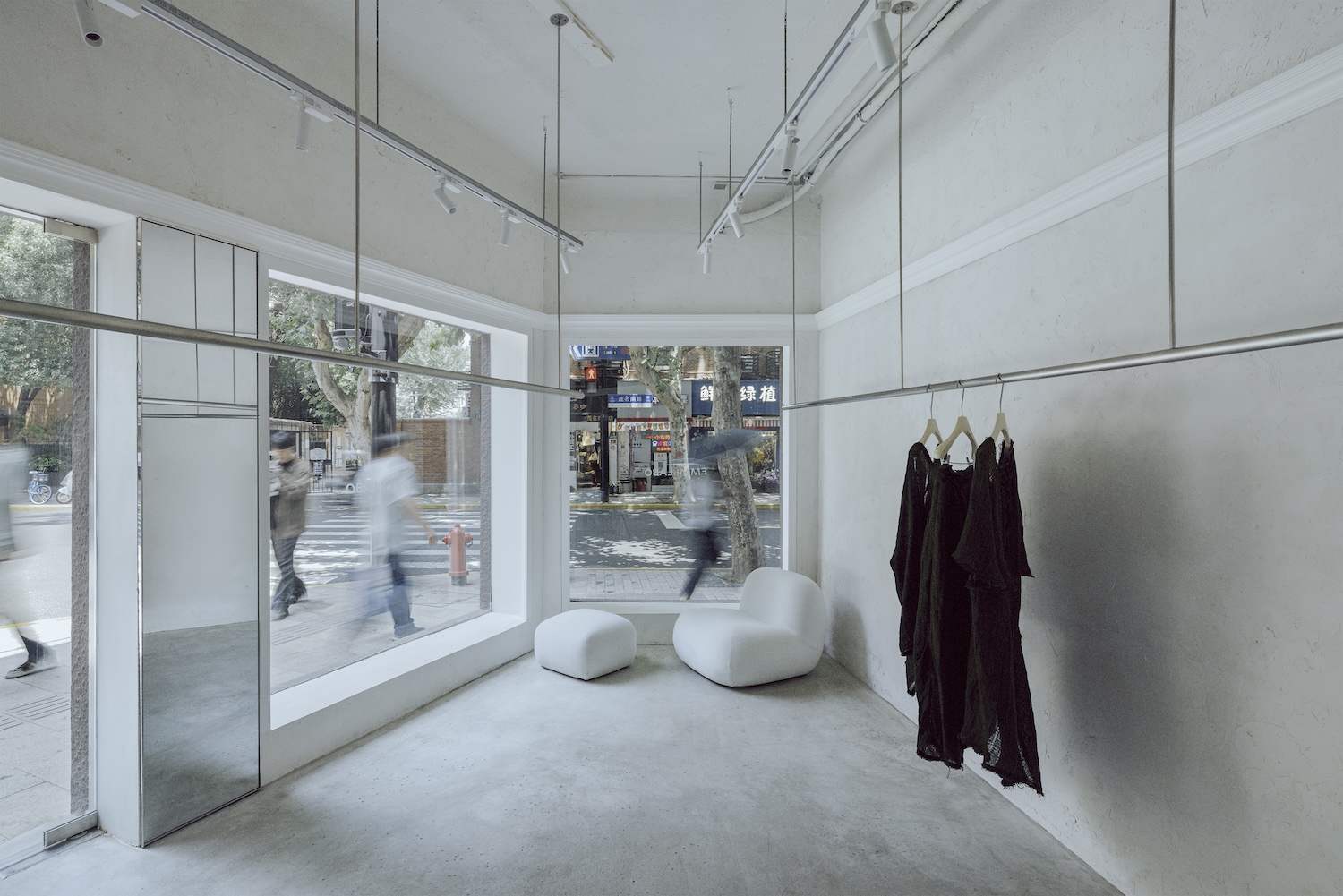
The site itself is an asset. Positioned at a high-traffic intersection along South Maoming Road, the corner location offers three full-height glass facades that dissolve the boundary between sidewalk and interior. Rather than competing for attention with oversized branding, the storefront carries only a handwritten note on the glass – erasable, impermanent, closer to a studio sketch than a corporate identity. It is a gesture that recalls the provisional signage of early Comme des Garçons guerrilla shops, where absence of branding became the brand signal itself. Here, the clothing does the communicating.
Inside, the spatial strategy hinges on a single organizing element: a continuous arrayed clothing wall that runs the length of the store. This sequential display system serves triple duty – it signals the shop’s function to passersby scanning through the glass, it directs circulation along a natural browsing path, and it establishes the visual rhythm of the entire interior. Garments hang in strict alignment, and the effect is closer to a gallery hang than a conventional rack layout, each piece given room to read as an individual object. The system echoes the kind of rigorous display logic Claudio Silvestrin brought to Giorgio Armani’s early flagship interiors, where merchandise presentation and architectural composition were treated as the same problem.
The irregular geometry of the historic building – angled corners and awkward pockets that would typically compromise a retail plan – gets absorbed into back-of-house functions. Fitting rooms, storage, and restrooms tuck into these residual zones, liberating the primary volume as a single uninterrupted surface for display. It is a planning move that treats spatial inefficiency as a resource rather than a limitation.