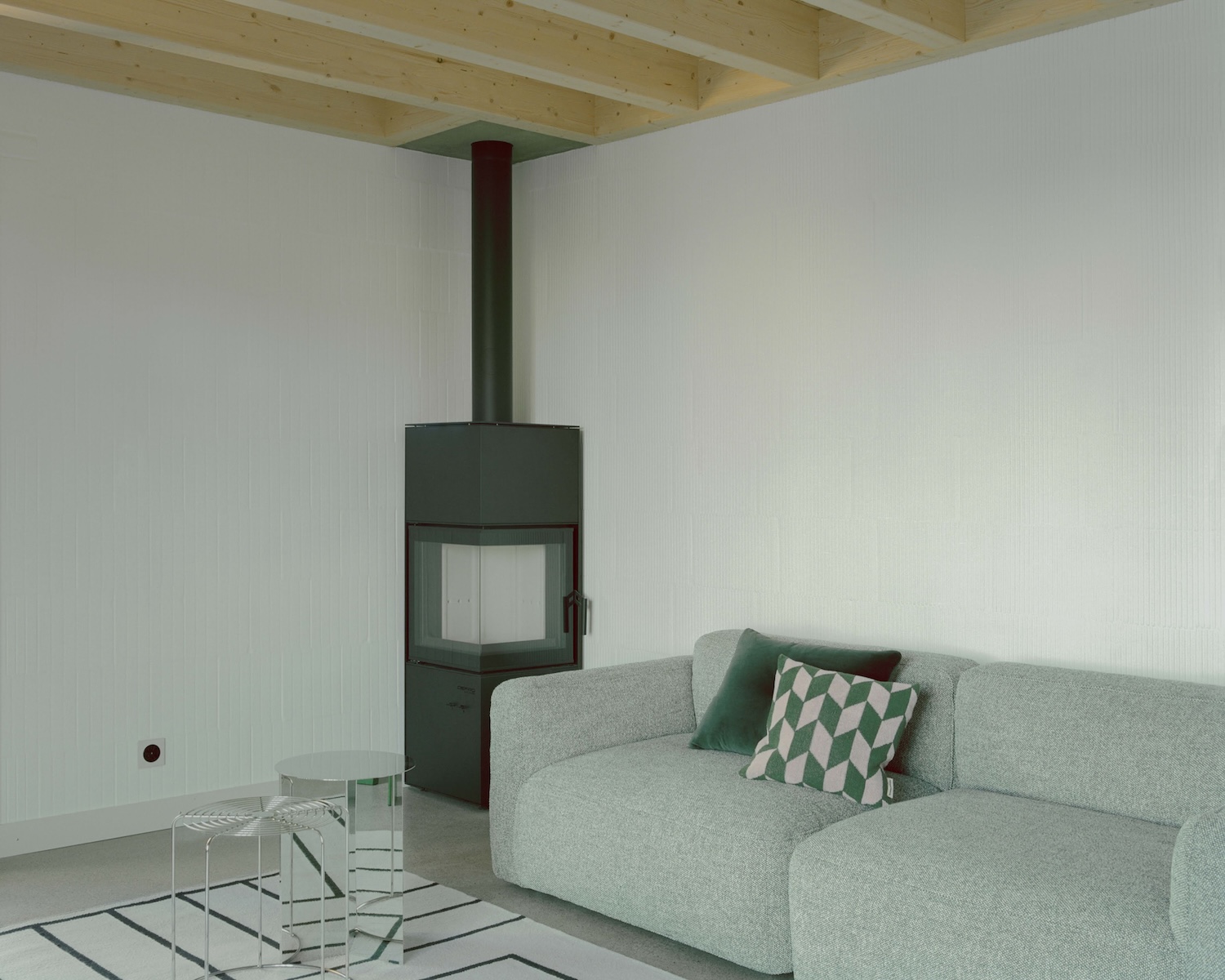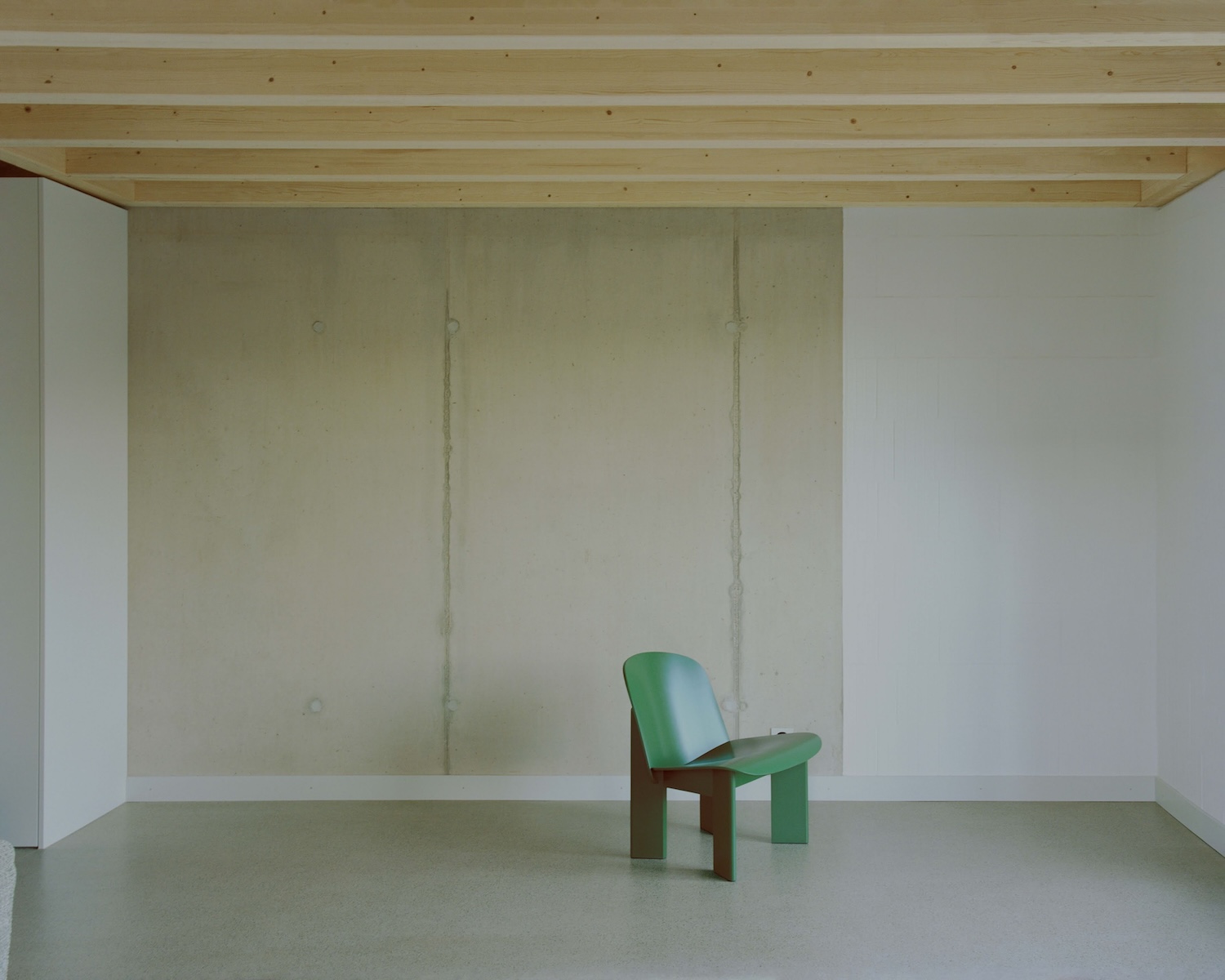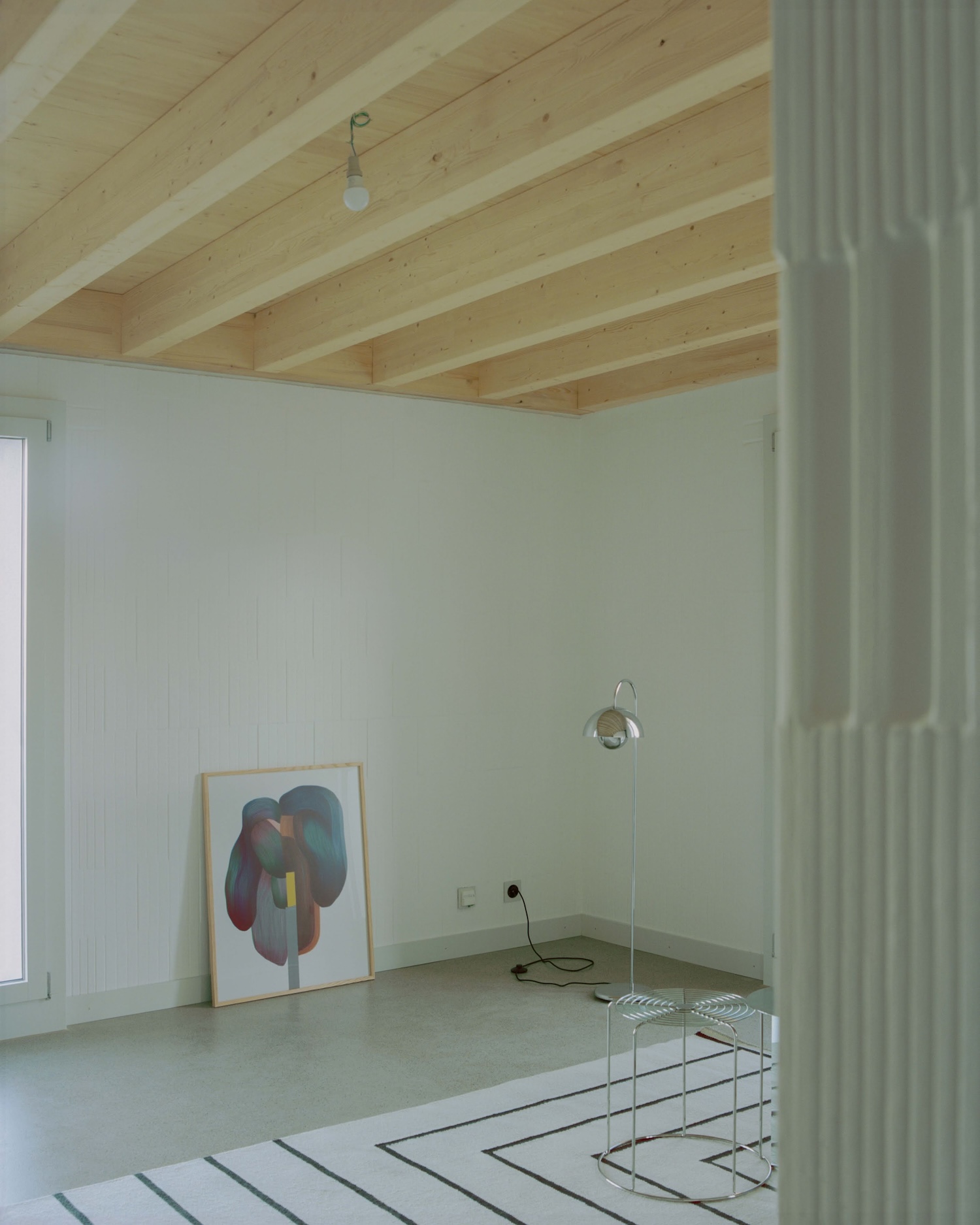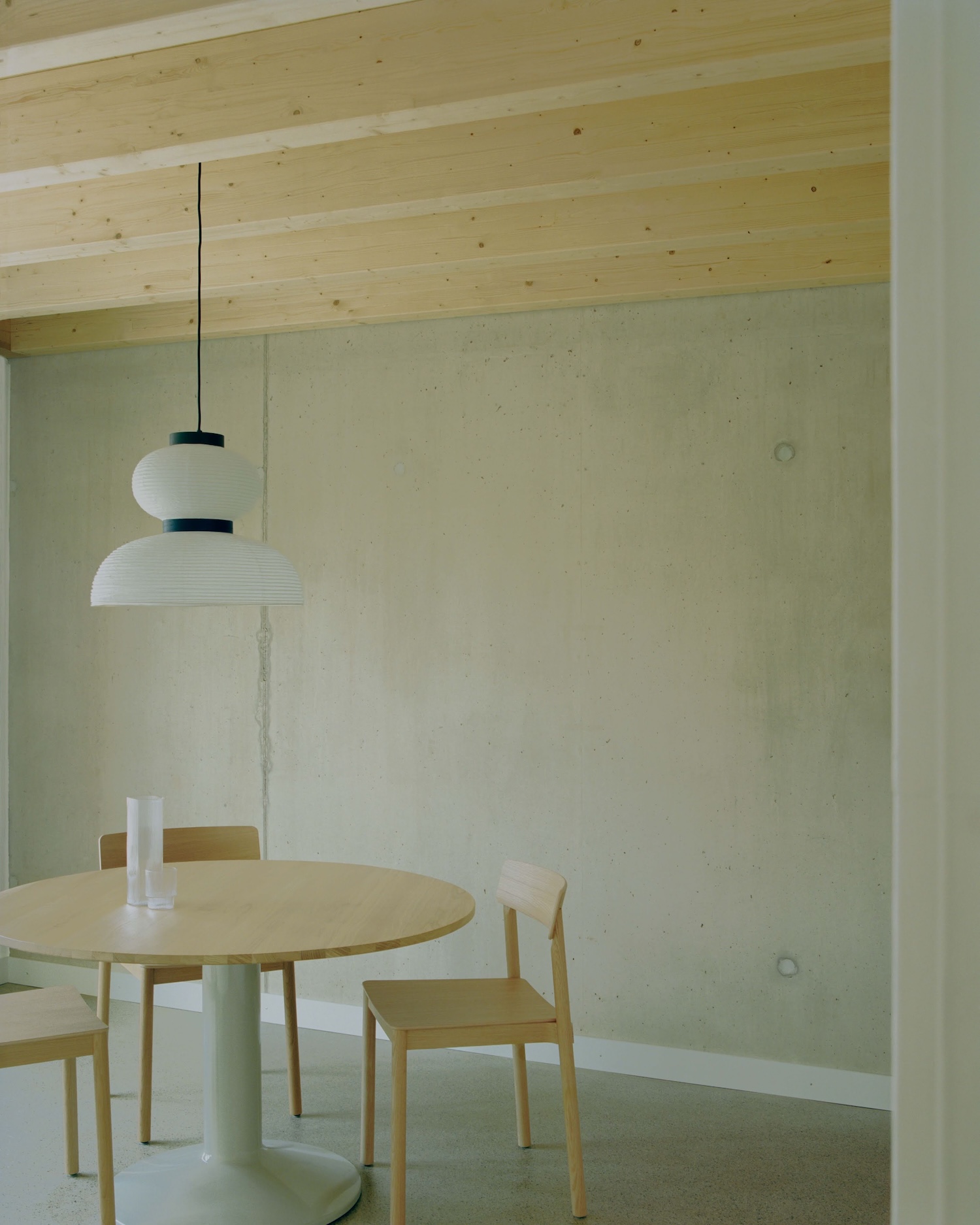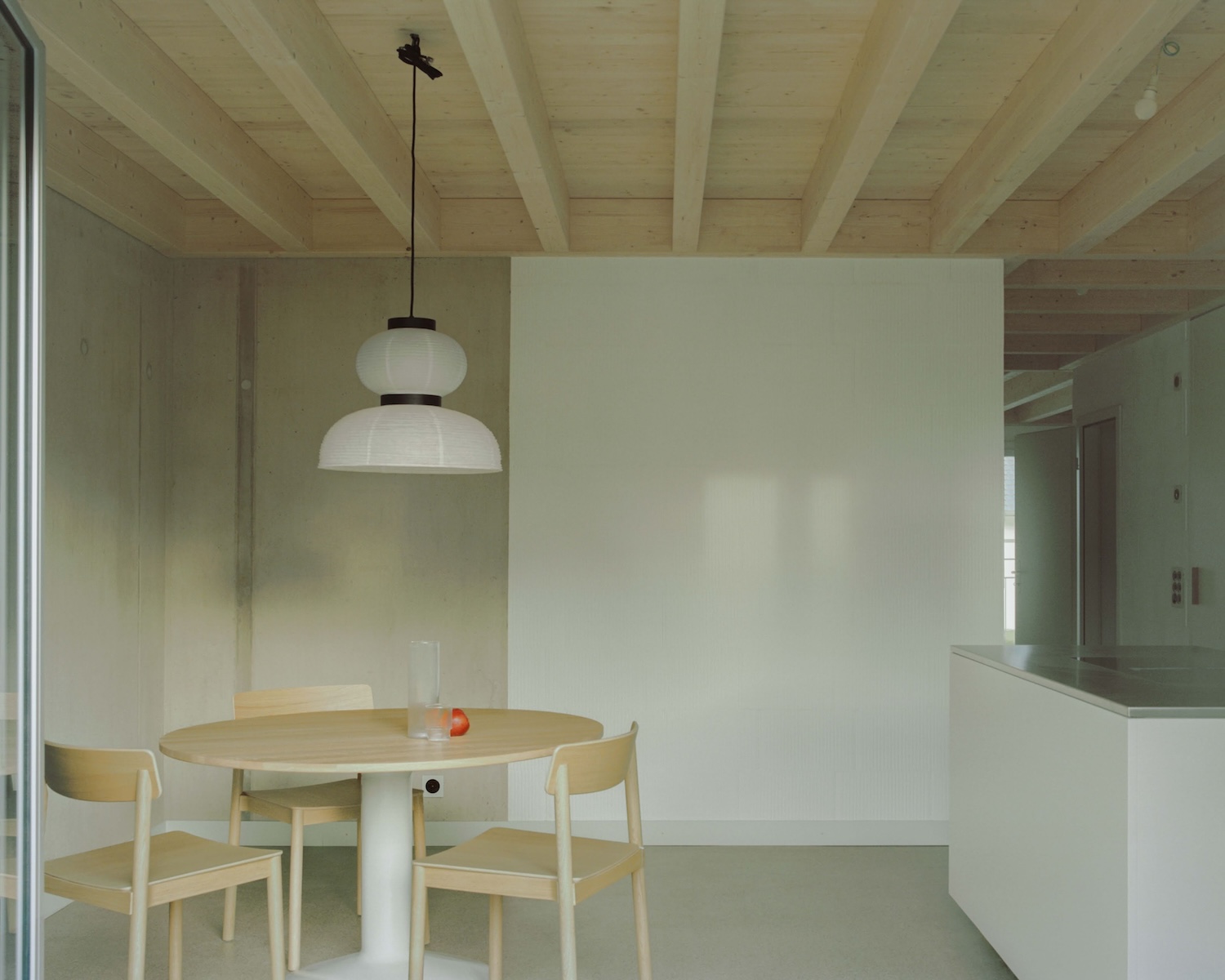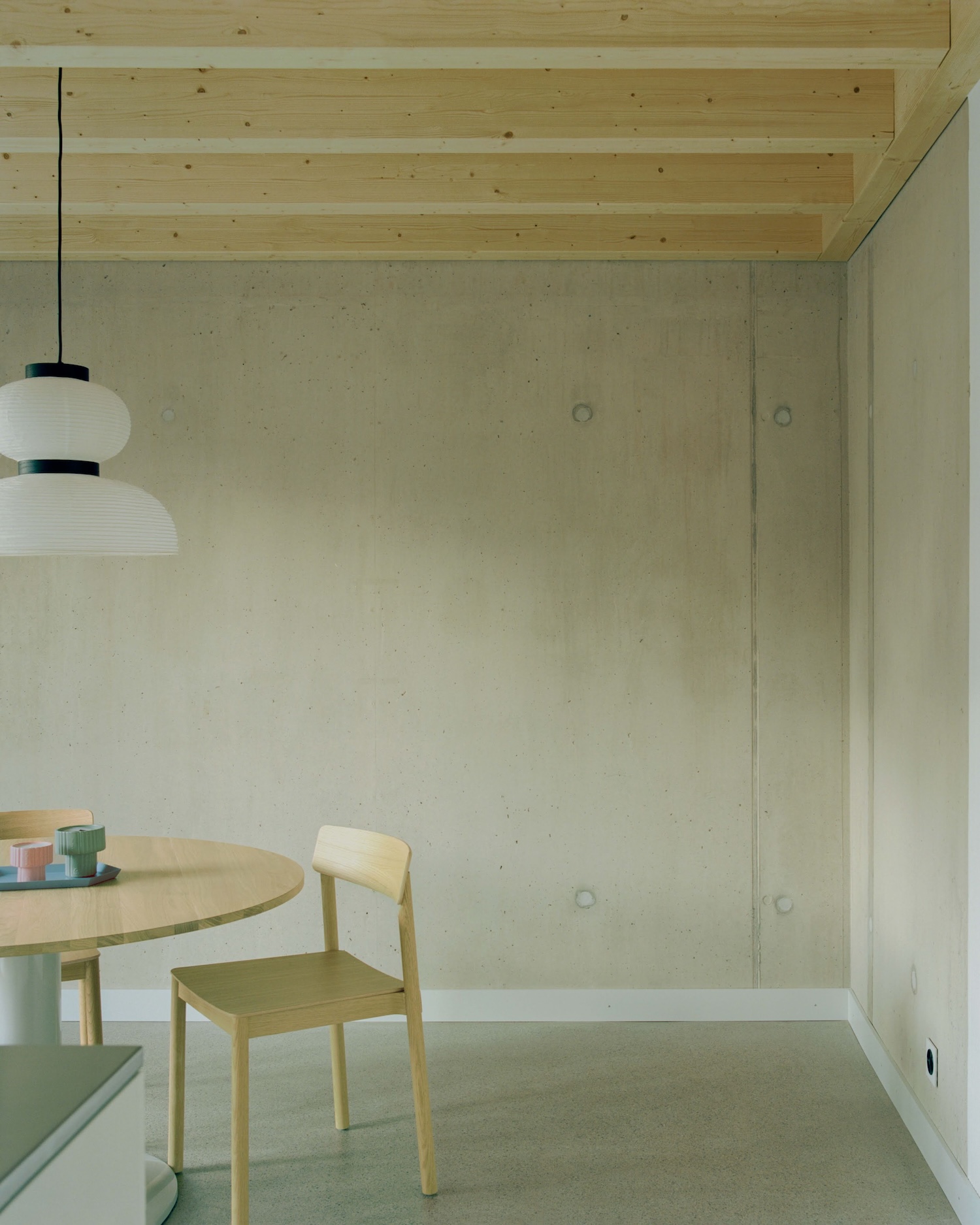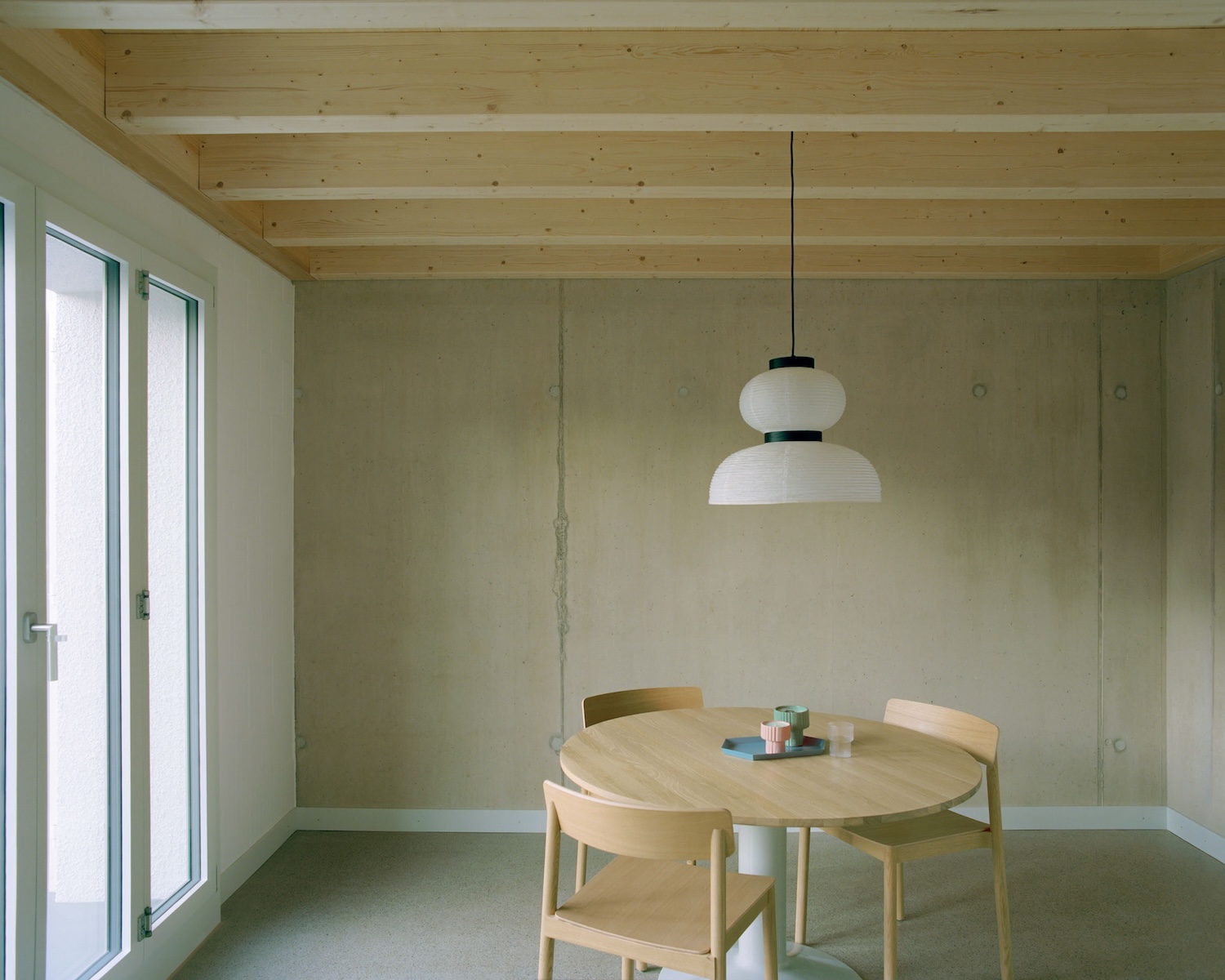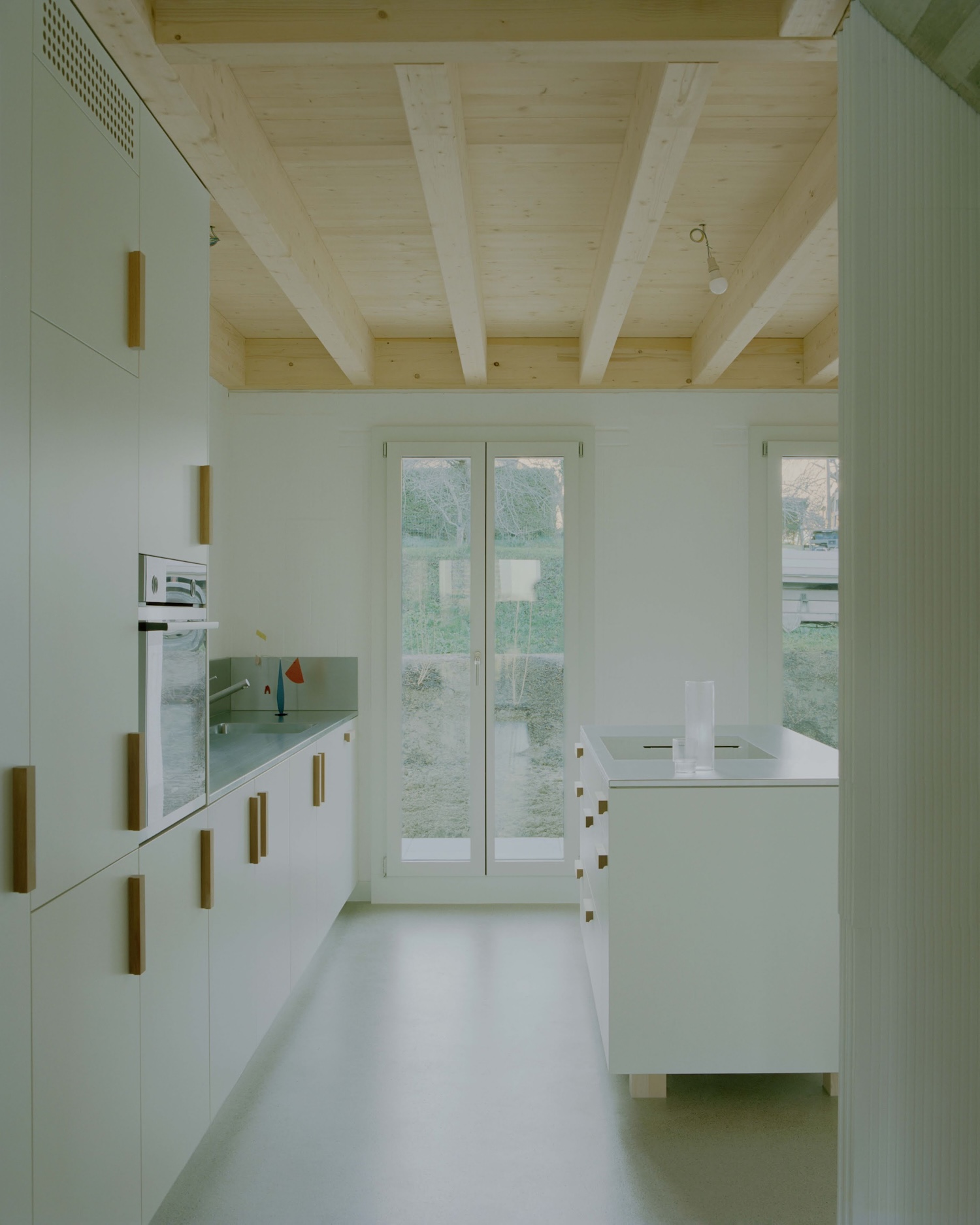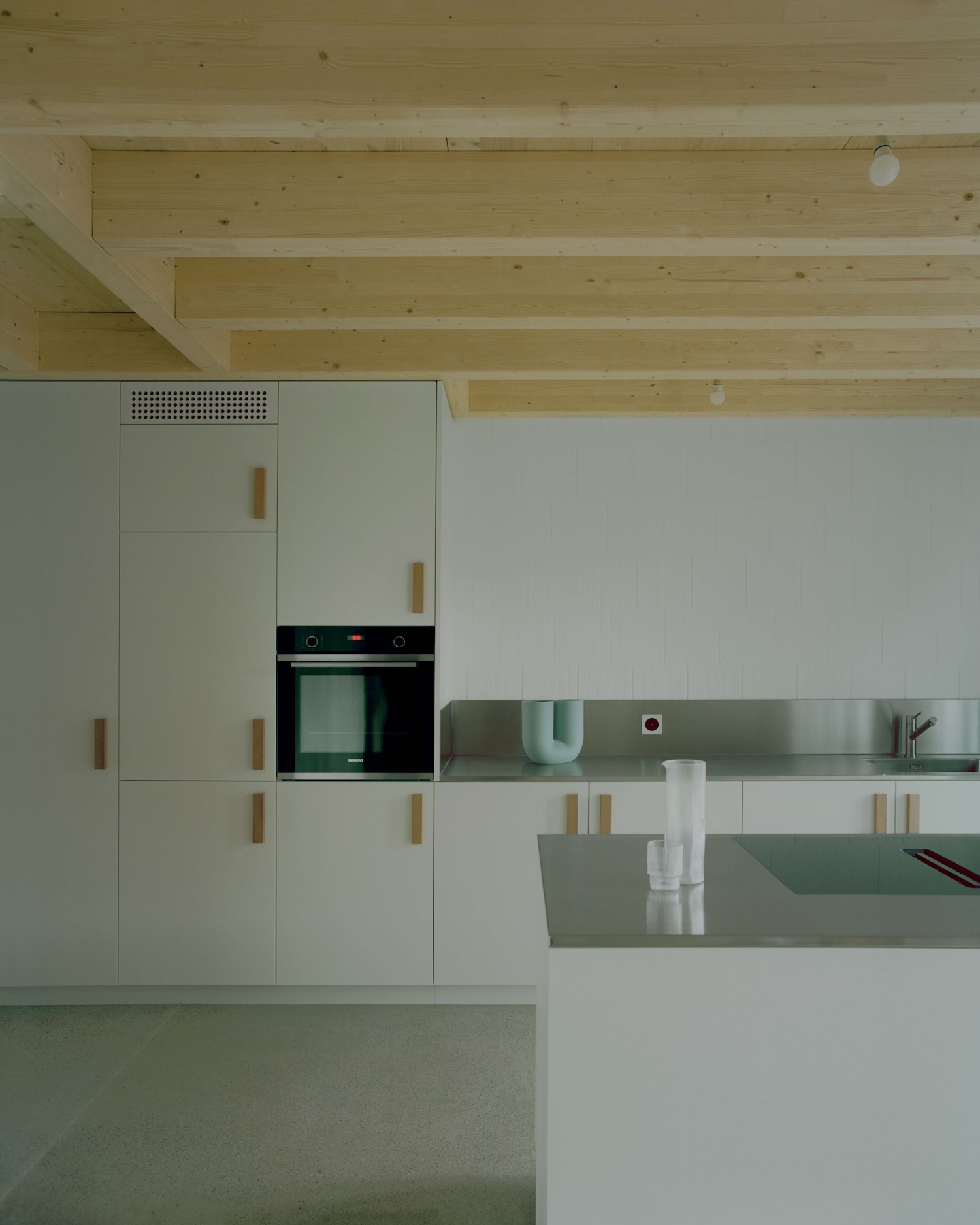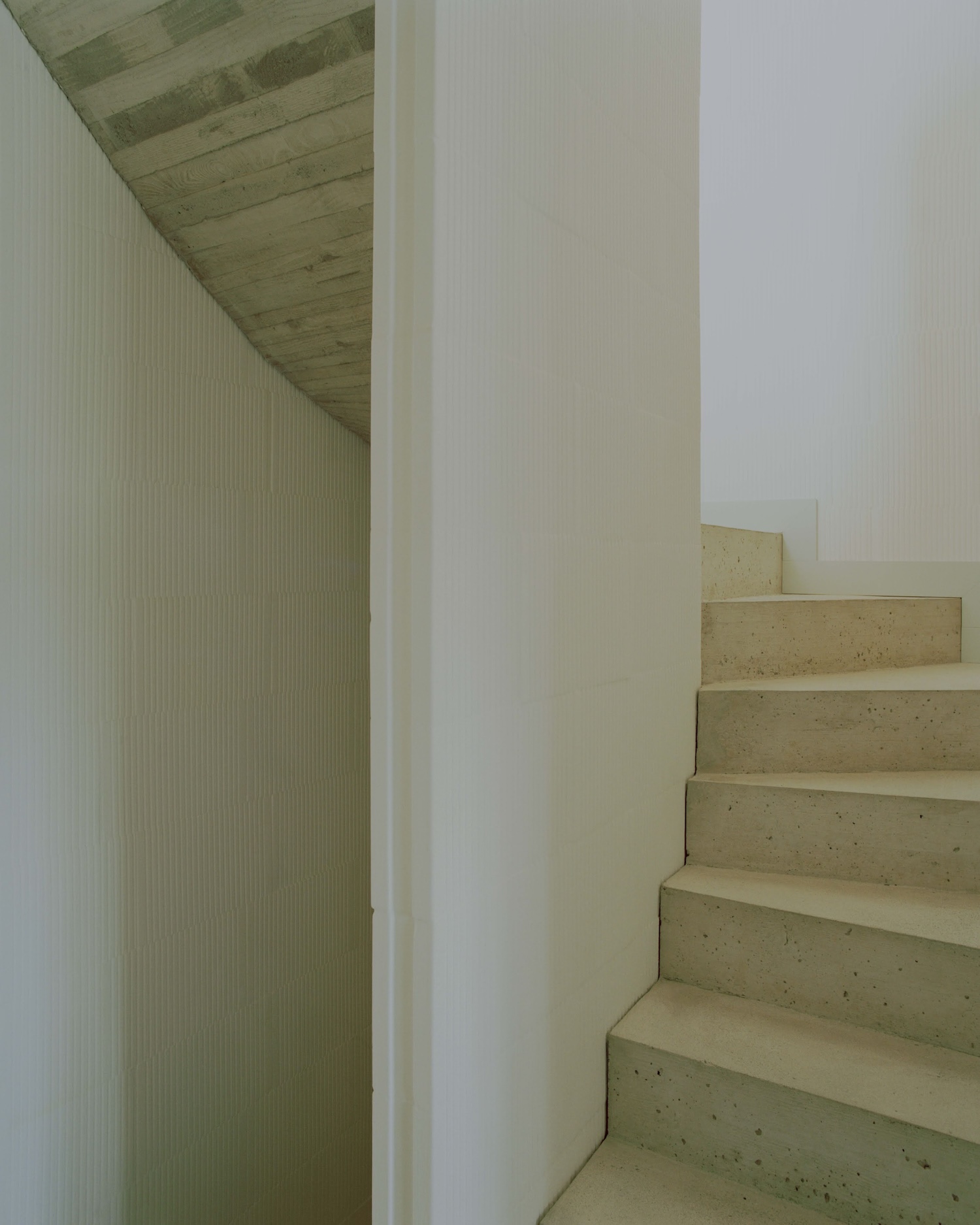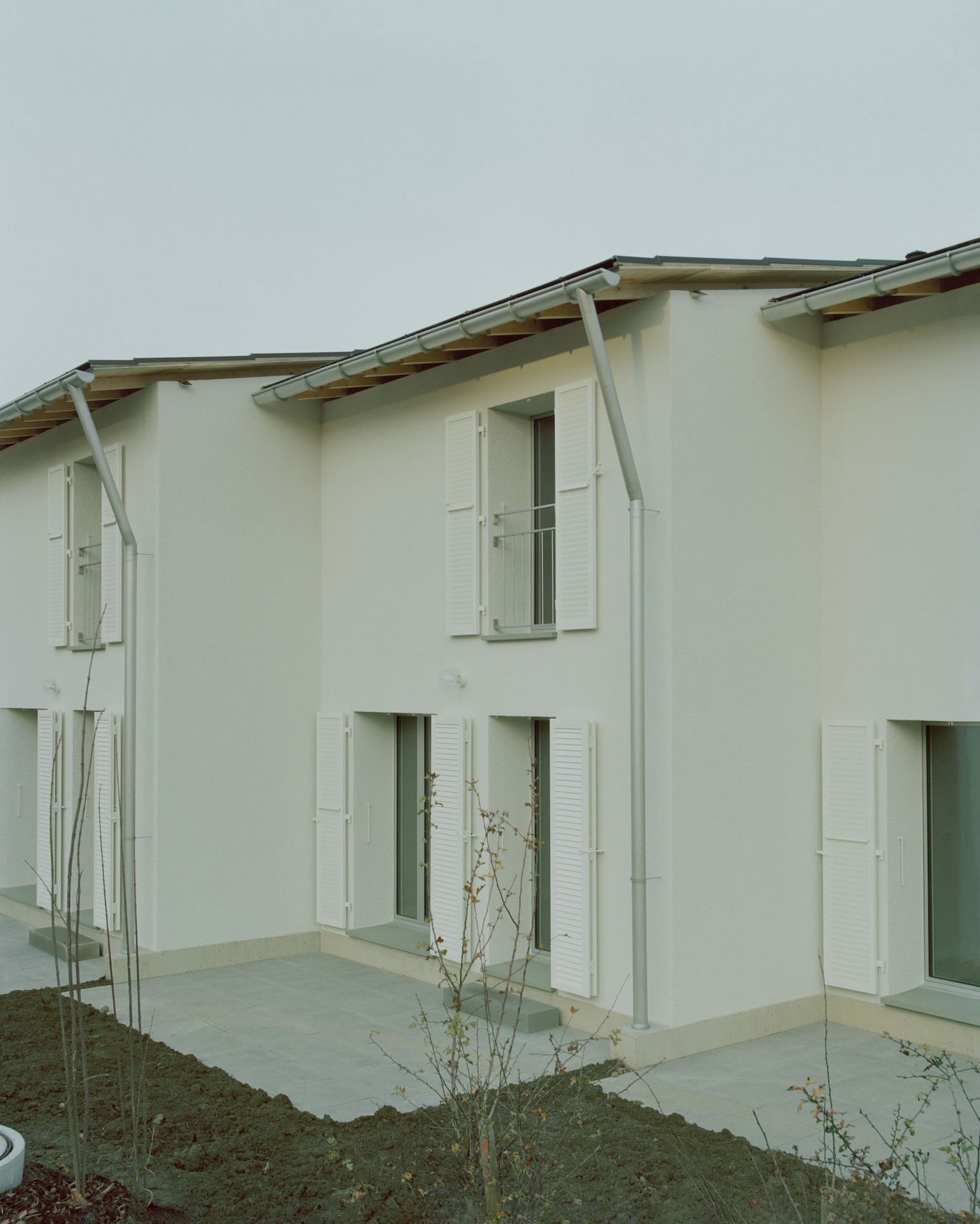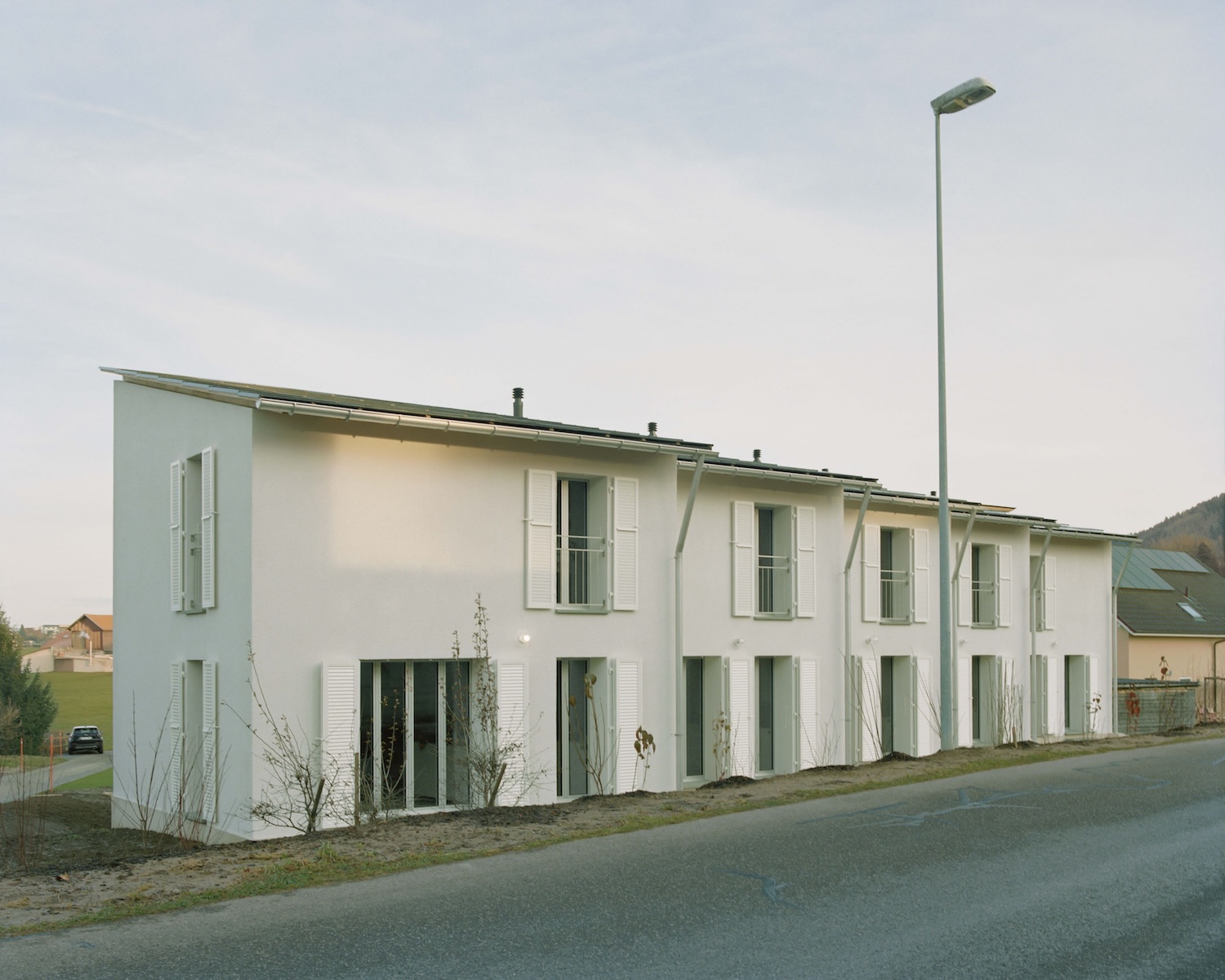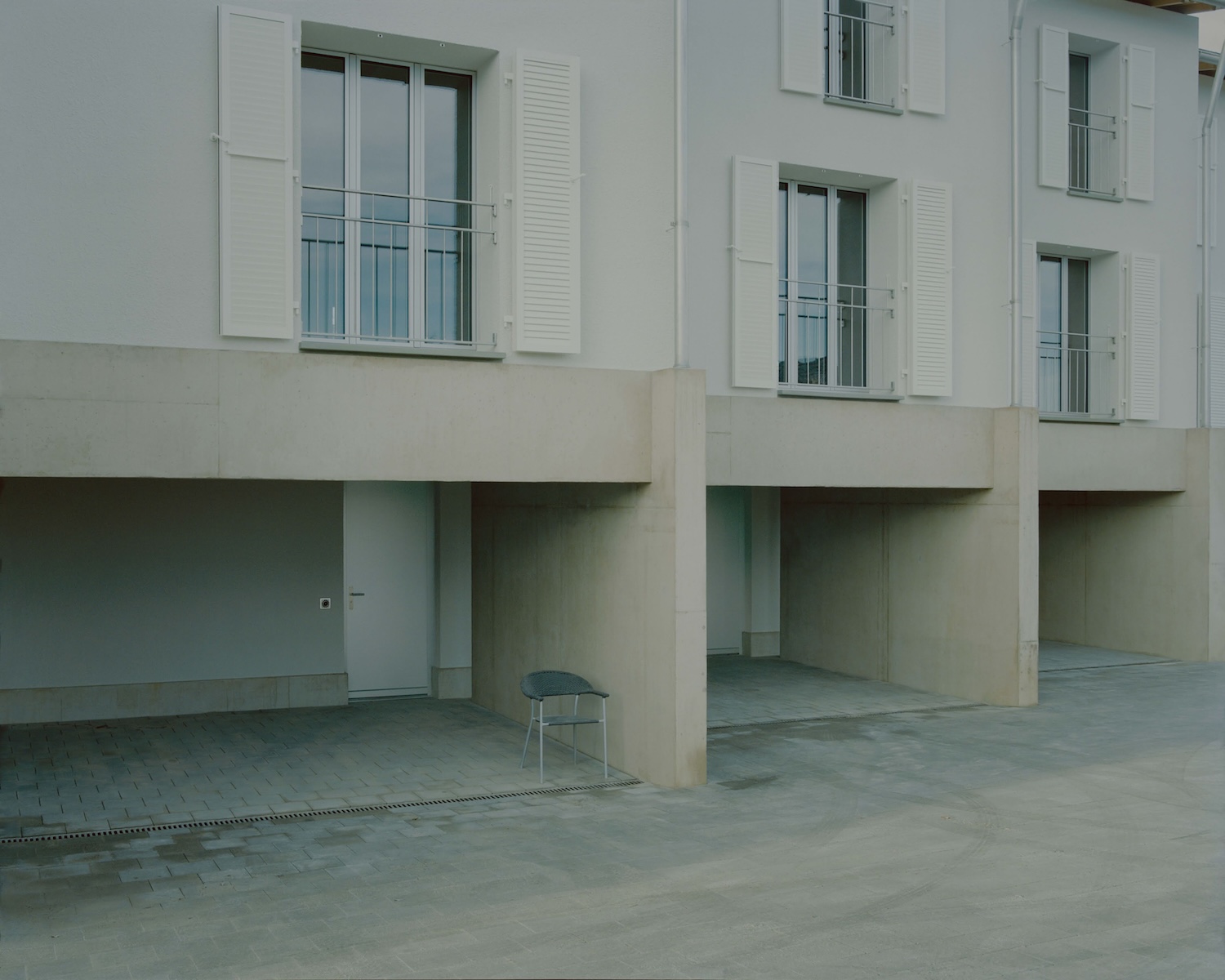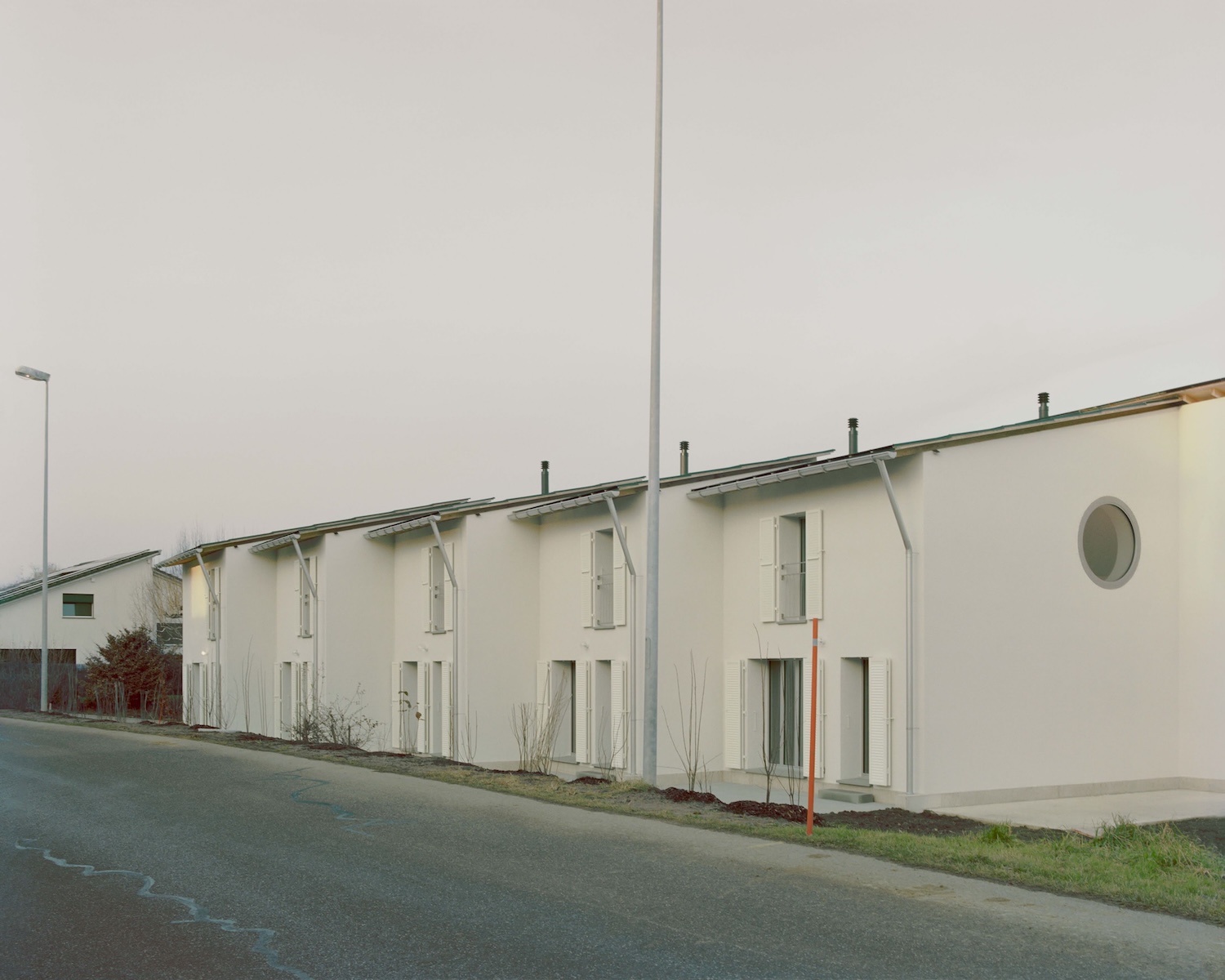
Five Villas is a minimalist residential development located in Villarsel-le-Gibloux, Switzerland, designed by noue. The triangular plot presented both a constraint and an opportunity. Rather than imposing a uniform grid, the designers used the site’s irregular geometry to distribute five villas in a staggered arrangement, breaking down what could have been an imposing residential block into a composition that reads more like an organic cluster than a planned development. This logic of disaggregation – fragmenting mass to achieve domestic scale – runs throughout the project, connecting material selection, structural hierarchy, and spatial organization into a coherent architectural argument.
The staggered layout produces a roof composition that rewards careful reading. Overlapping pitched forms follow the stepping of the volumes, while flat-roofed insertions at each center accommodate the level shifts introduced by the site’s natural slope. These central zones, housing circulation and service functions, act as quiet hinges between the expressive pitched elements, giving each villa a clear functional hierarchy without resorting to formal complexity for its own sake.
Orientation is used deliberately to reinforce the separation of living modes. Entrances face east, marked by covered parking that anchors arrival without ceremony. On the west, main living areas open directly to gardens at grade, dissolving the boundary between interior and exterior in a move that aligns with a long tradition of modernist domesticity – where the wall becomes a threshold rather than a barrier. Bedrooms occupy the upper level, positioned to capture unobstructed views while maintaining acoustic and visual separation from shared spaces below.
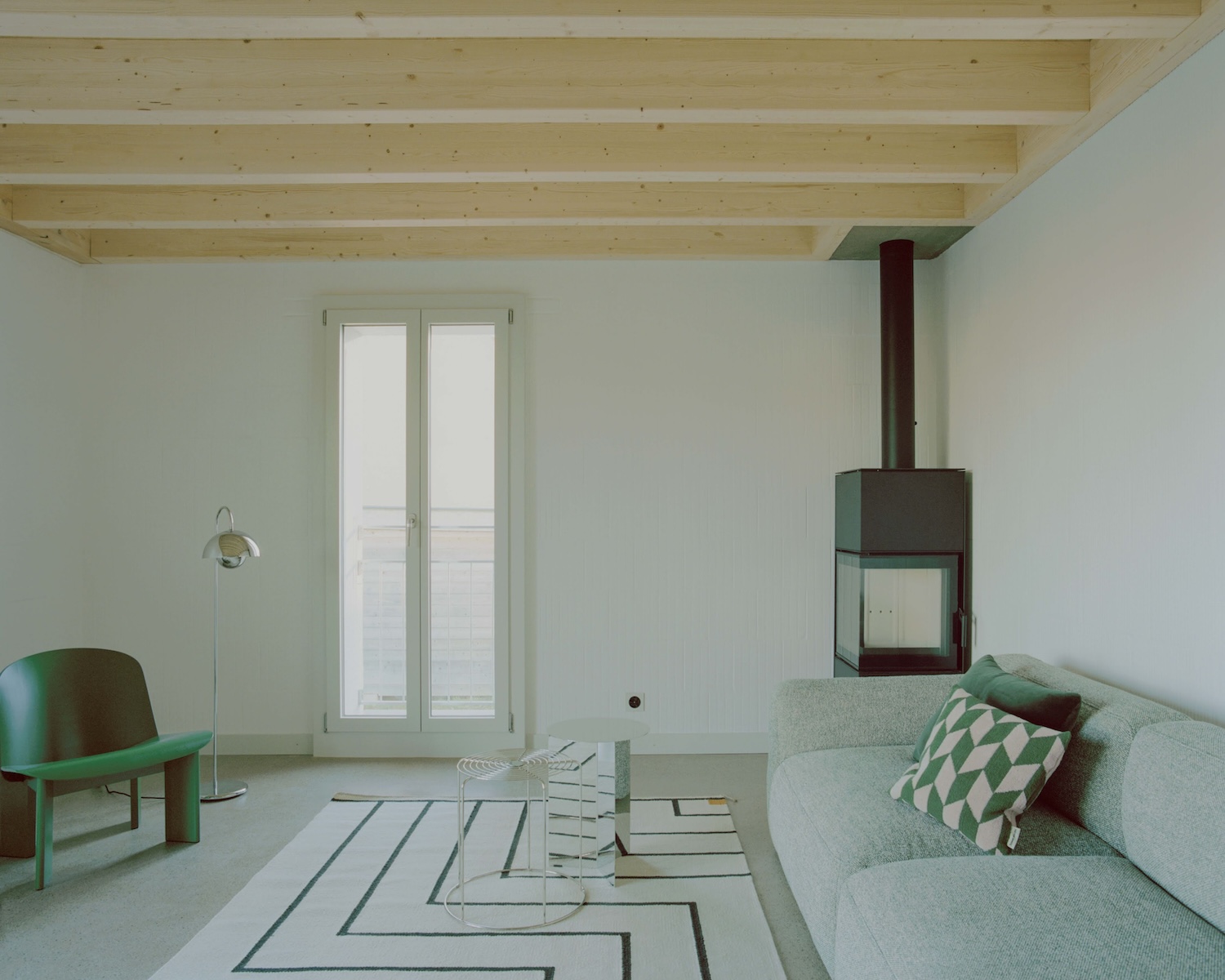
The material palette draws on regional precedent without resorting to pastiche. Solid insulating brick forms the primary structural enclosure, chosen for its thermal inertia – a quality that moderates both summer heat gain and winter heat loss without mechanical compensation. The choice echoes the massive rubble-stone walls of local farmhouses, reinterpreting vernacular construction logic through a contemporary building system. Lime plaster finishes and anhydrite screeds extend this commitment to natural regulation, managing humidity and thermal comfort in ways that cement-based systems cannot replicate with the same nuance.