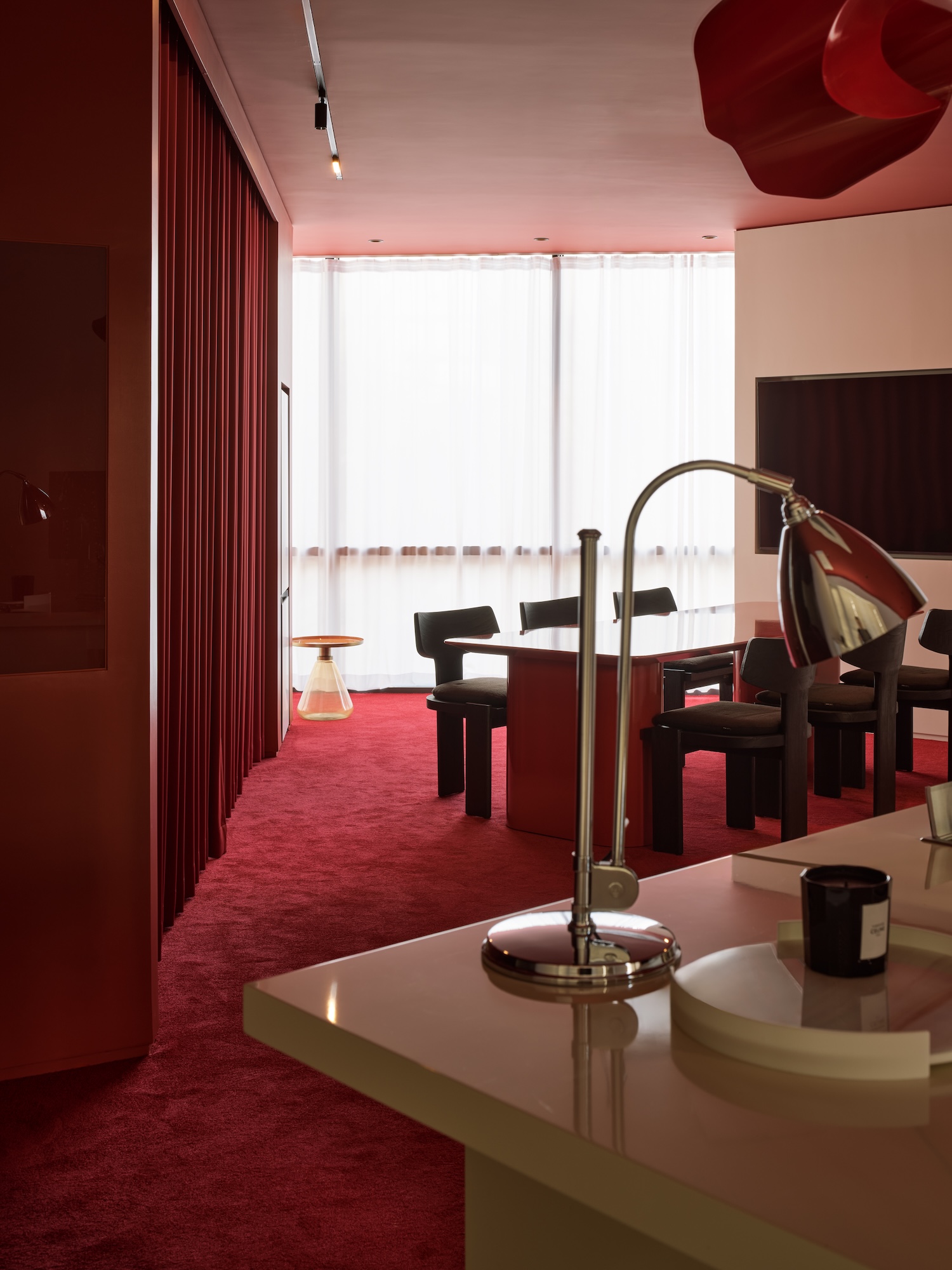
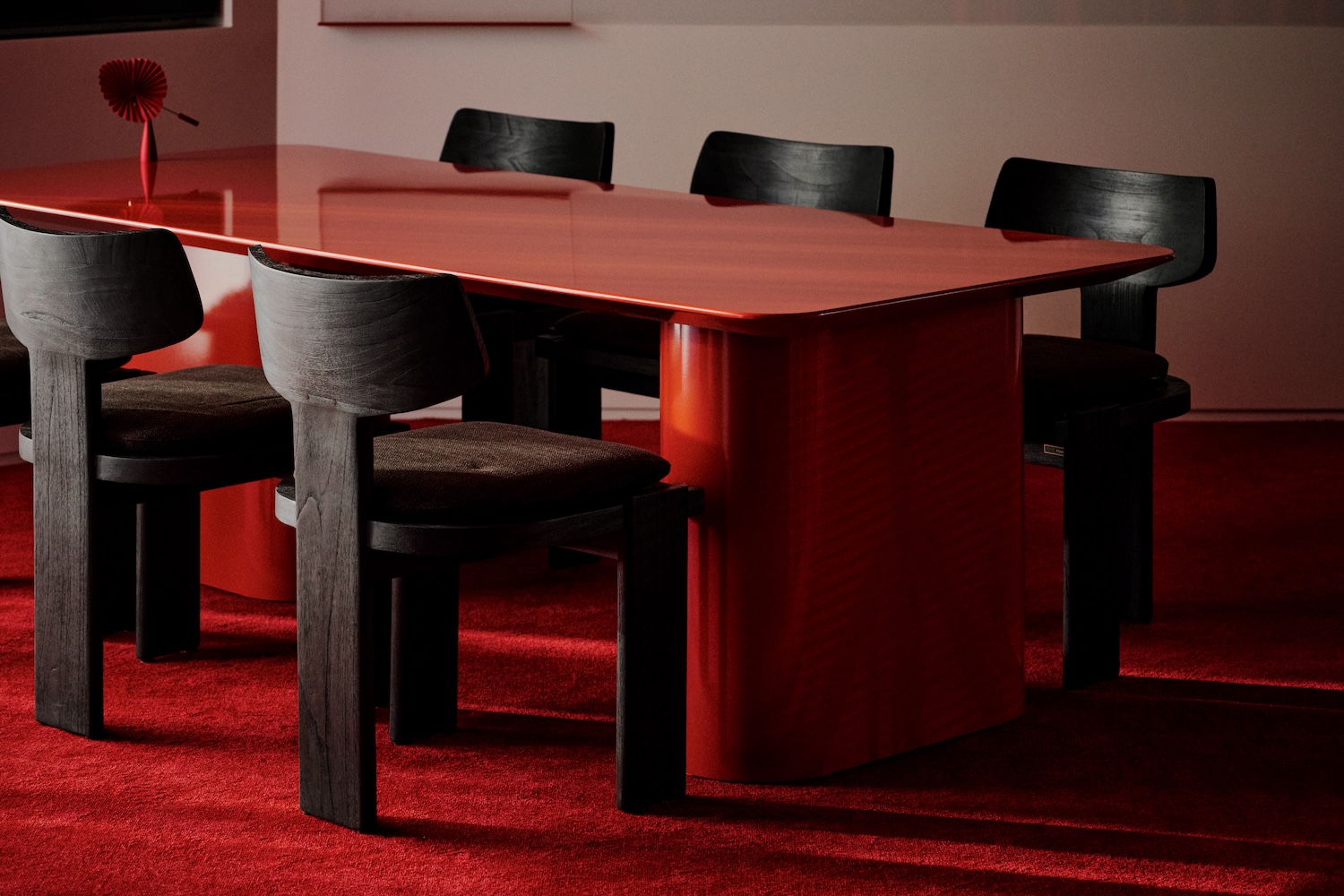
L Office is a minimalist office located in Seoul, South Korea, designed by ALX Design. Red is an unusual choice for a space demanding sustained concentration. In most workplace design, the color is treated as too stimulating, too charged with cultural associations ranging from urgency to aggression, to hold up across hours of focused work. ALX challenges this assumption in L Office, a 100-square-meter private office in Seoul’s Mapo-gu district, by stripping the color down to its quietest register. The result is a chromatic experiment that reframes red not as an activating force but as a grounding one.
The approach depends entirely on restraint. Rather than deploying red as an accent or statement element, ALX commits to it as the envelope itself – ceiling, floor, and walls unified into a single continuous field. At this saturation and value, the color loses its urgency and takes on something closer to depth. The space reads less like a bold interior choice and more like a considered atmosphere, the kind that defines high-end hospitality design but rarely crosses into the private office typology.
Against this field, white furniture and structural columns perform a precise visual function. The contrast is not decorative but calibrated: the white elements read as objects within the red environment rather than as interruptions of it, preserving the coherence of the overall composition while articulating individual zones of work. The low ledge running through the workspace reinforces this quality, creating a horizontal datum that emphasizes settled, forward focus over the vertical openness typically used to signal collaborative energy.
Glass and black accents are introduced with similar economy. The glass maintains visual continuity between meeting and working zones, allowing the two programs to remain distinct without becoming isolated – a relationship that reflects how contemporary knowledge work actually operates, with individual concentration and collective exchange existing in close proximity. The black, used sparingly, adds the material weight that prevents the palette from feeling too resolved, too smooth.