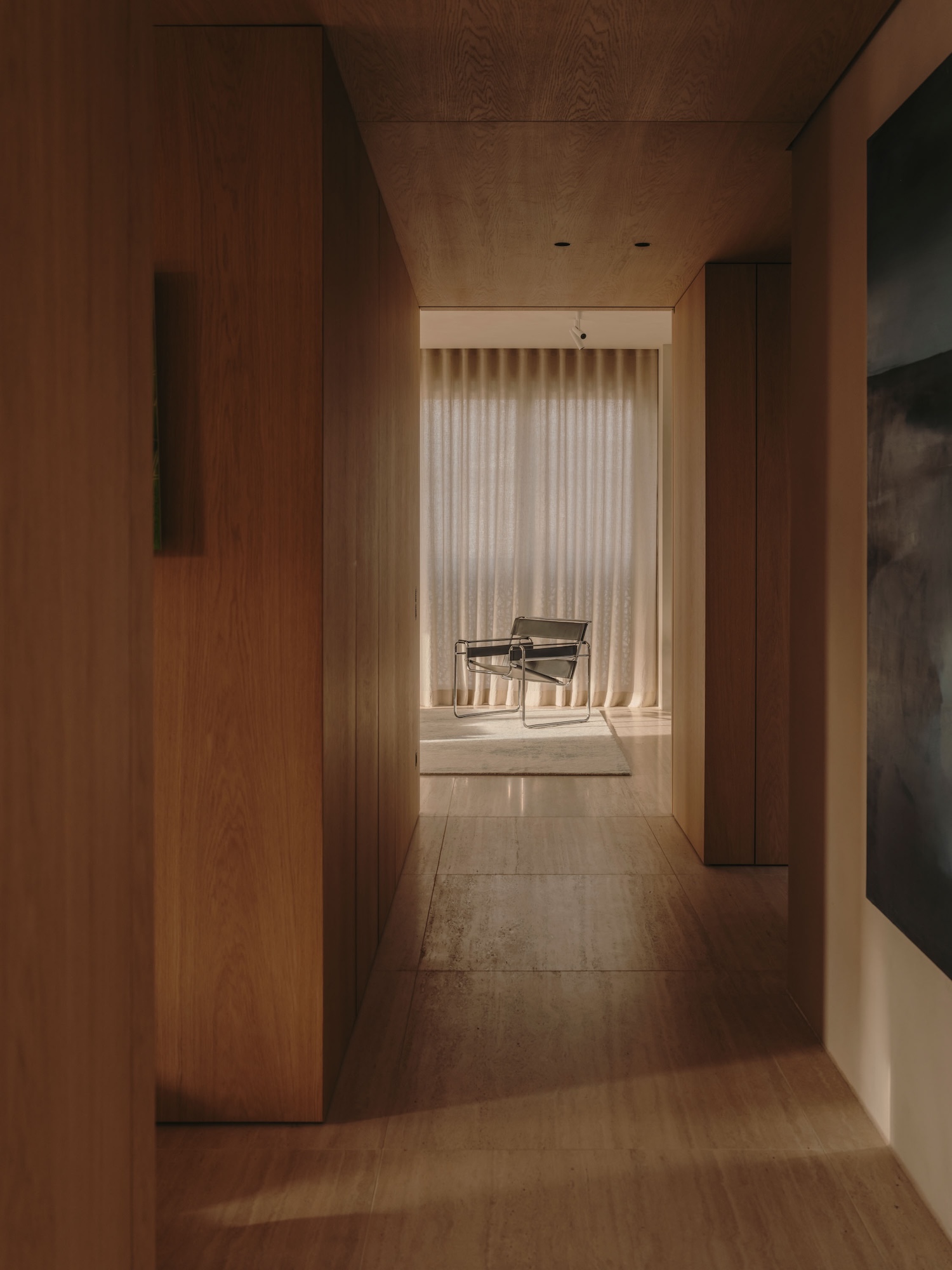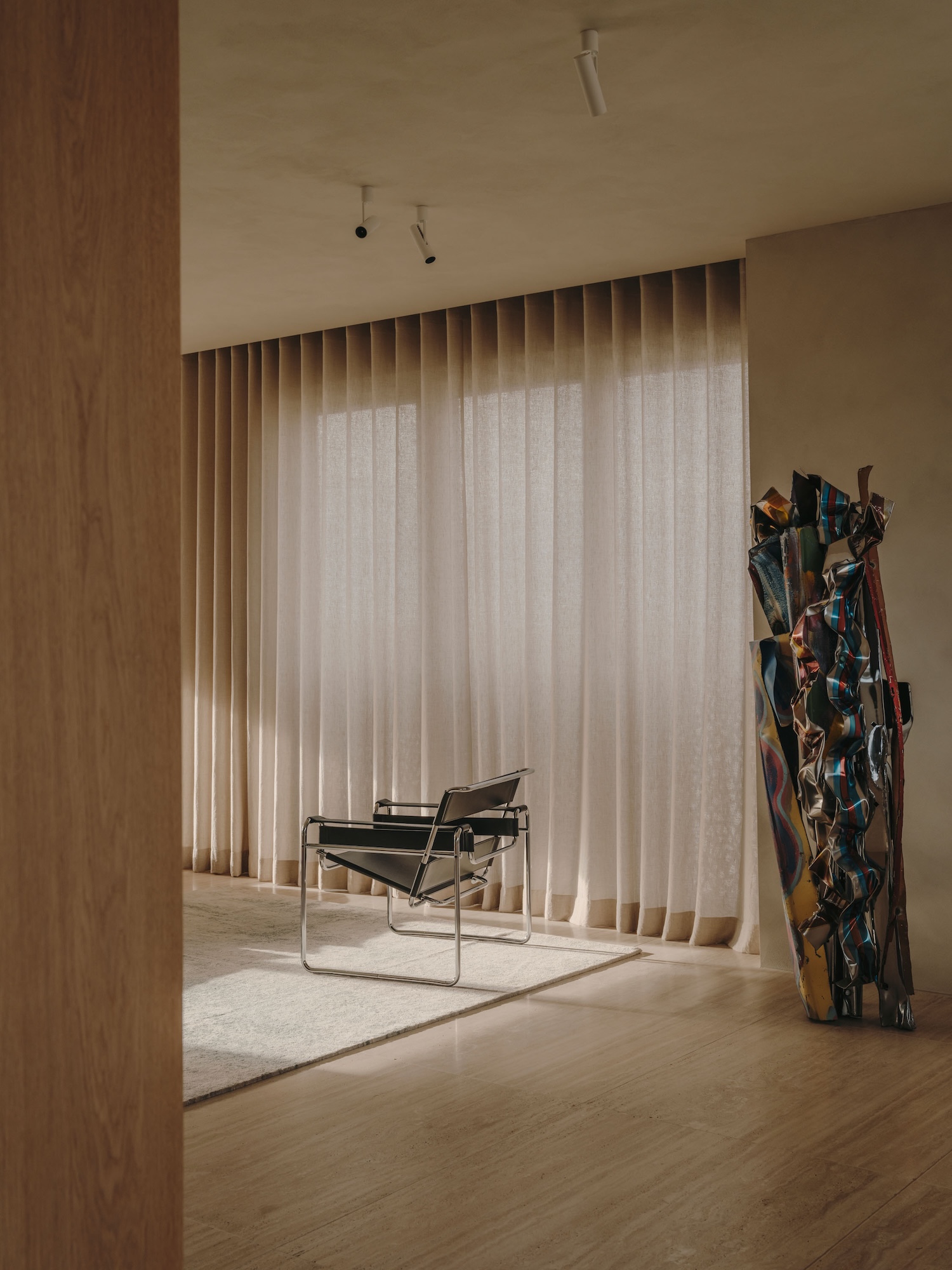
Munich on Top is a minimalist apartment located in Munich, Germany, designed by Holzrausch Studio. The project addresses a fundamental tension in contemporary urban living – how to maintain spatial generosity while preserving moments of intimacy within a nearly 300-square-meter penthouse defined by floor-to-ceiling glazing. Rather than defaulting to conventional room divisions that would fragment the dramatic panorama of city and mountains, Holzrausch conceived a central wooden core that functions as both architecture and furniture, enabling the space to shift between complete openness and discrete enclosure.
This core element reveals the studio’s integration of design conception and workshop fabrication – a vertical timber volume that houses functional necessities while establishing a circulation loop throughout the apartment. Sliding panels within this structure allow rooms to connect or separate as needed, a strategy that maintains visual continuity while offering practical flexibility. The approach recalls Japanese spatial concepts where architecture creates potential rather than fixed program, though expressed here through European craft traditions and materiality.
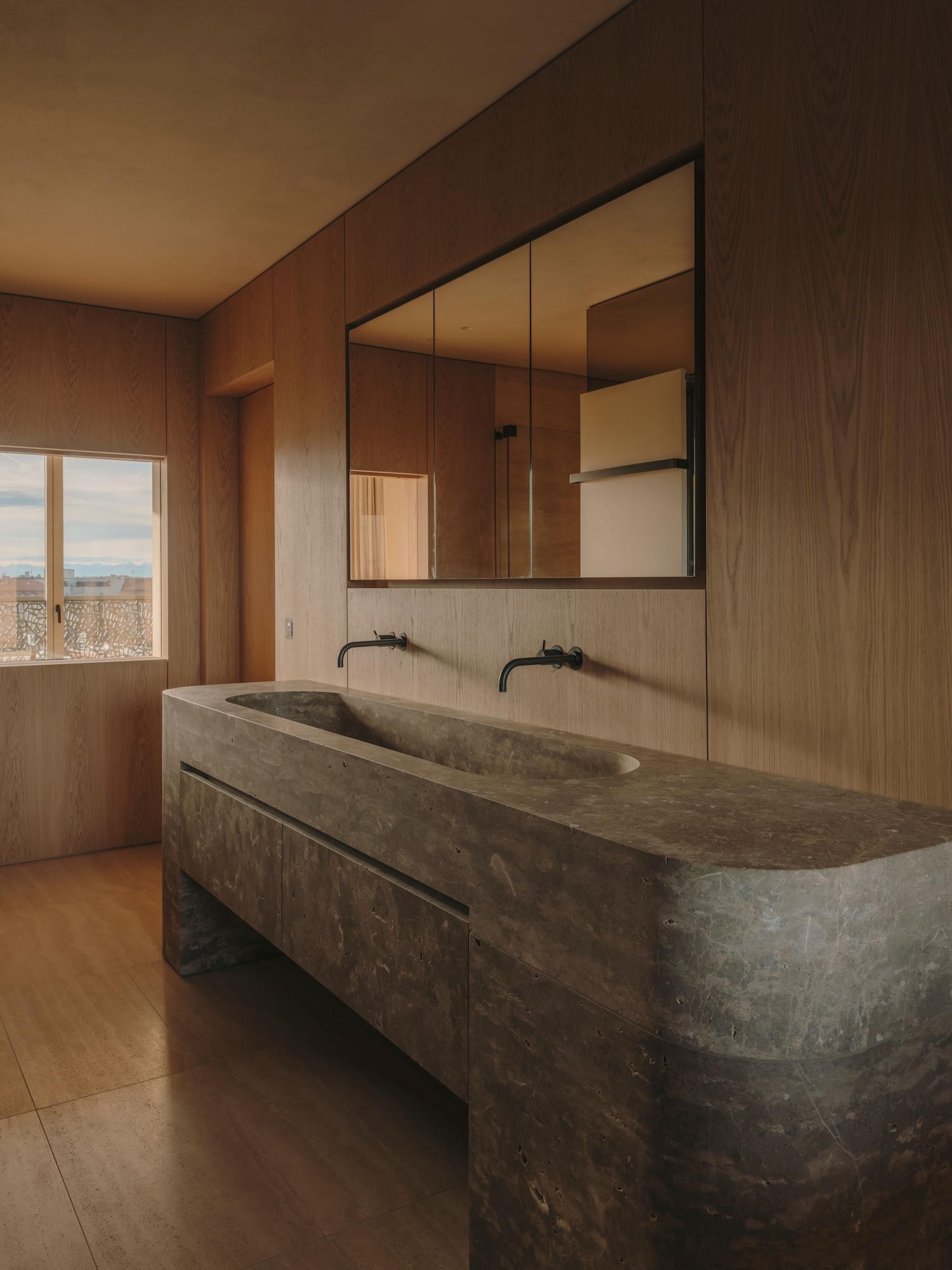
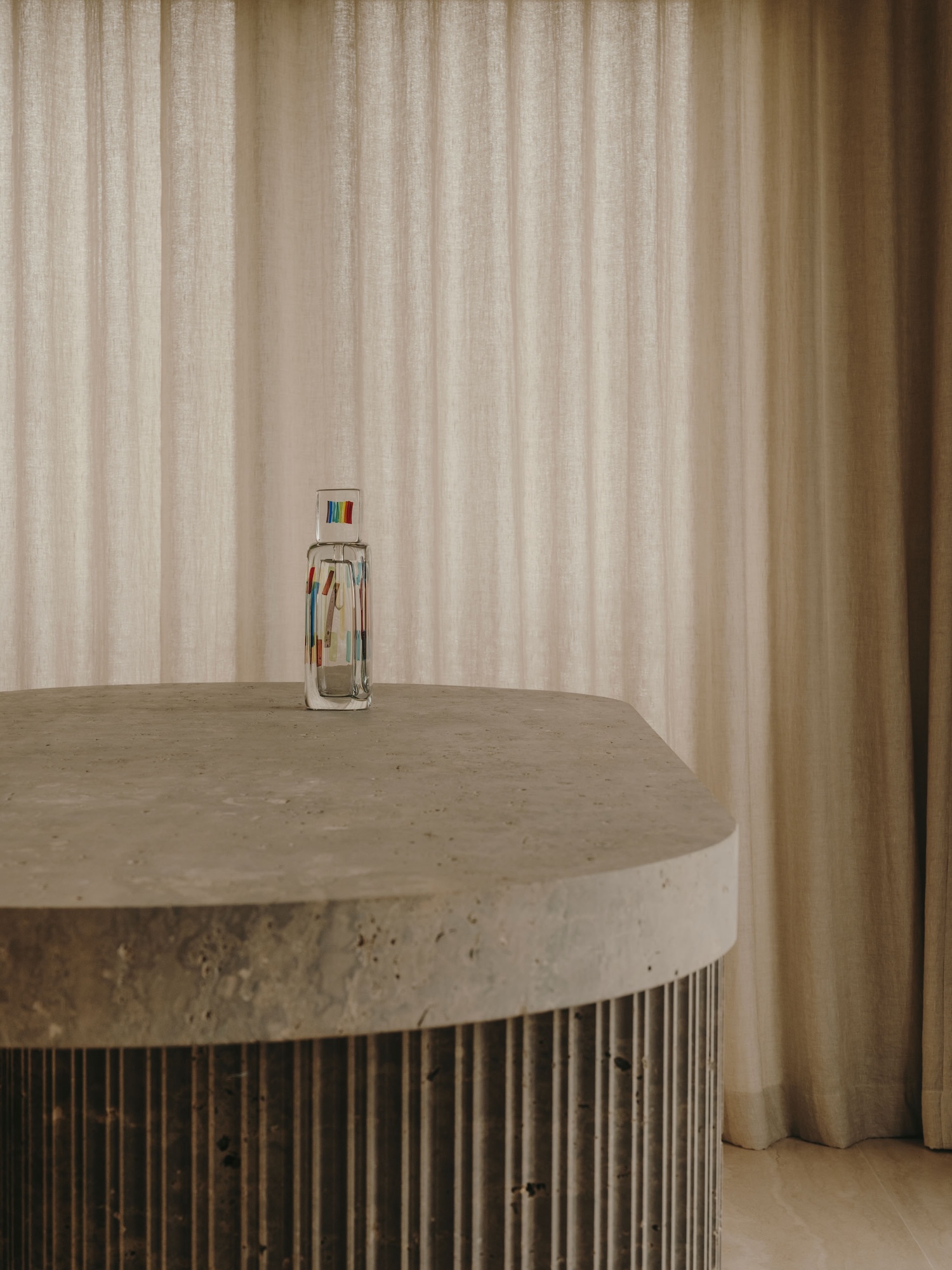
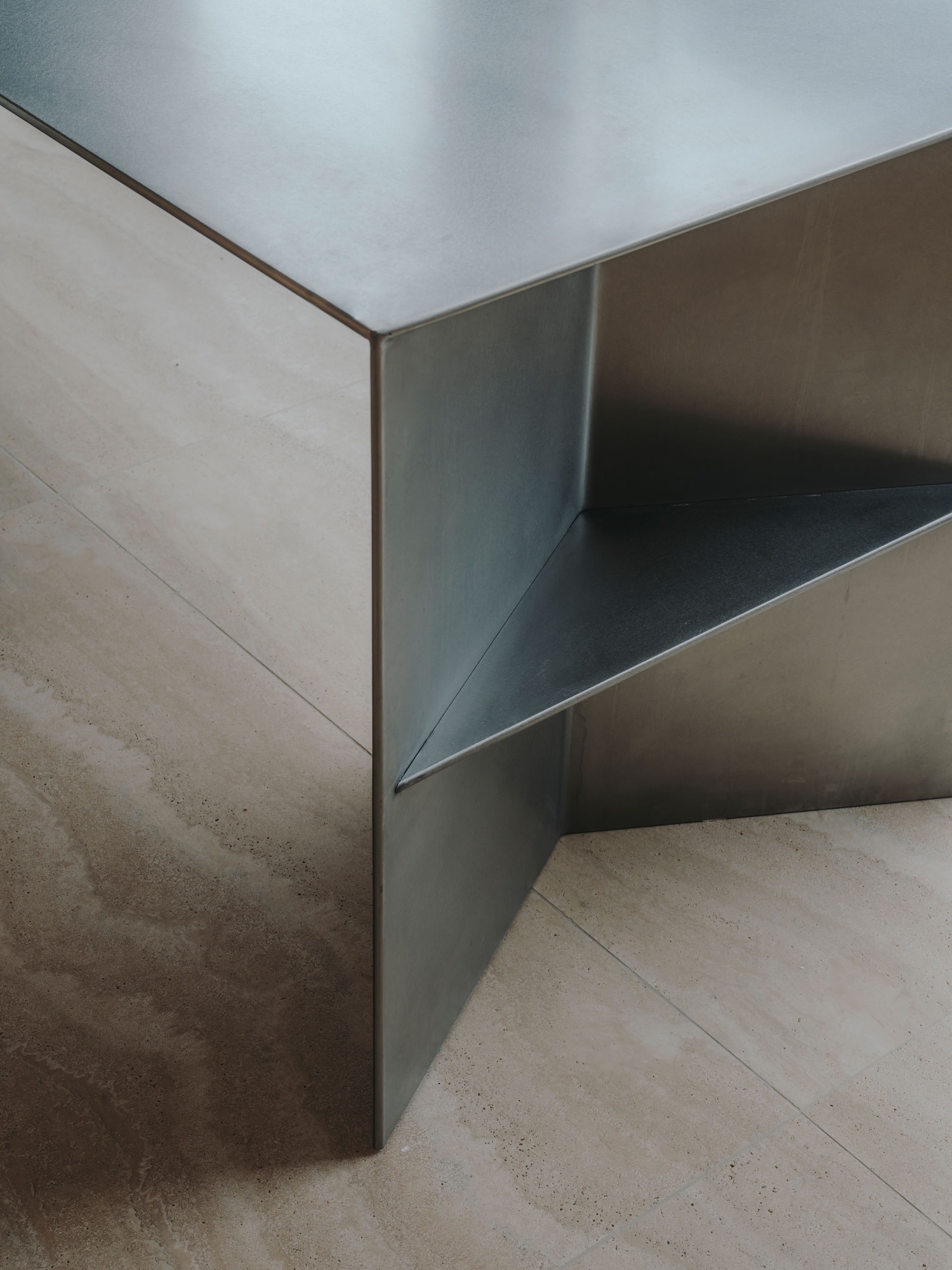
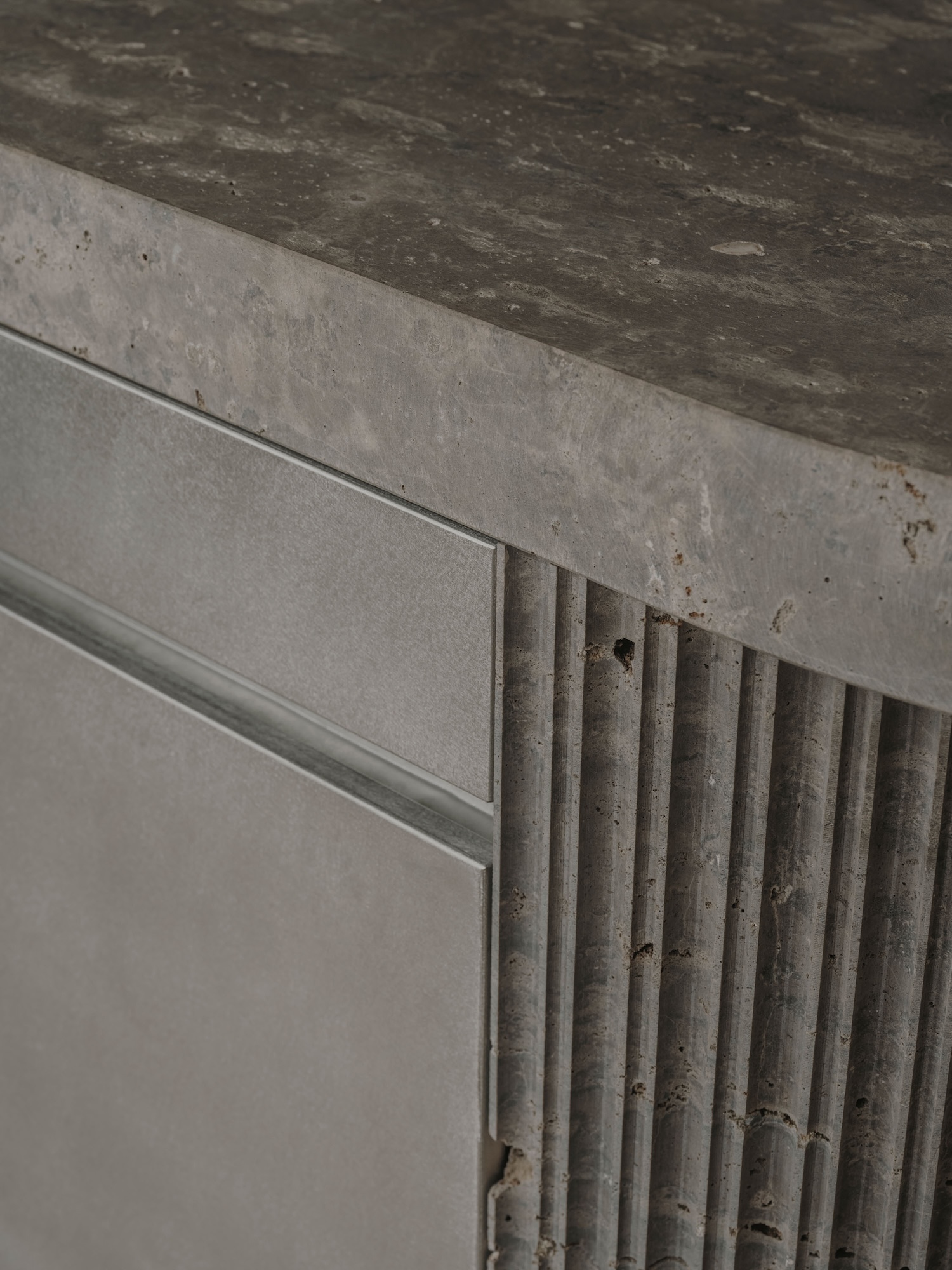
The material palette demonstrates restraint verging on austerity, built around travertine floors, oak veneer, and Wachenzeller Dolomit – a German limestone with subtle veining that appears in both the bar and bathroom washbasins. The bar positioning capitalizes on the penthouse’s most compelling view, its stainless steel fronts finished with a swirl technique that catches light without introducing visual noise. This attention to surface treatment extends throughout, from the Matteo Brioni plaster walls to the brushed stainless steel details, creating tonal cohesion that allows the surrounding landscape to dominate.
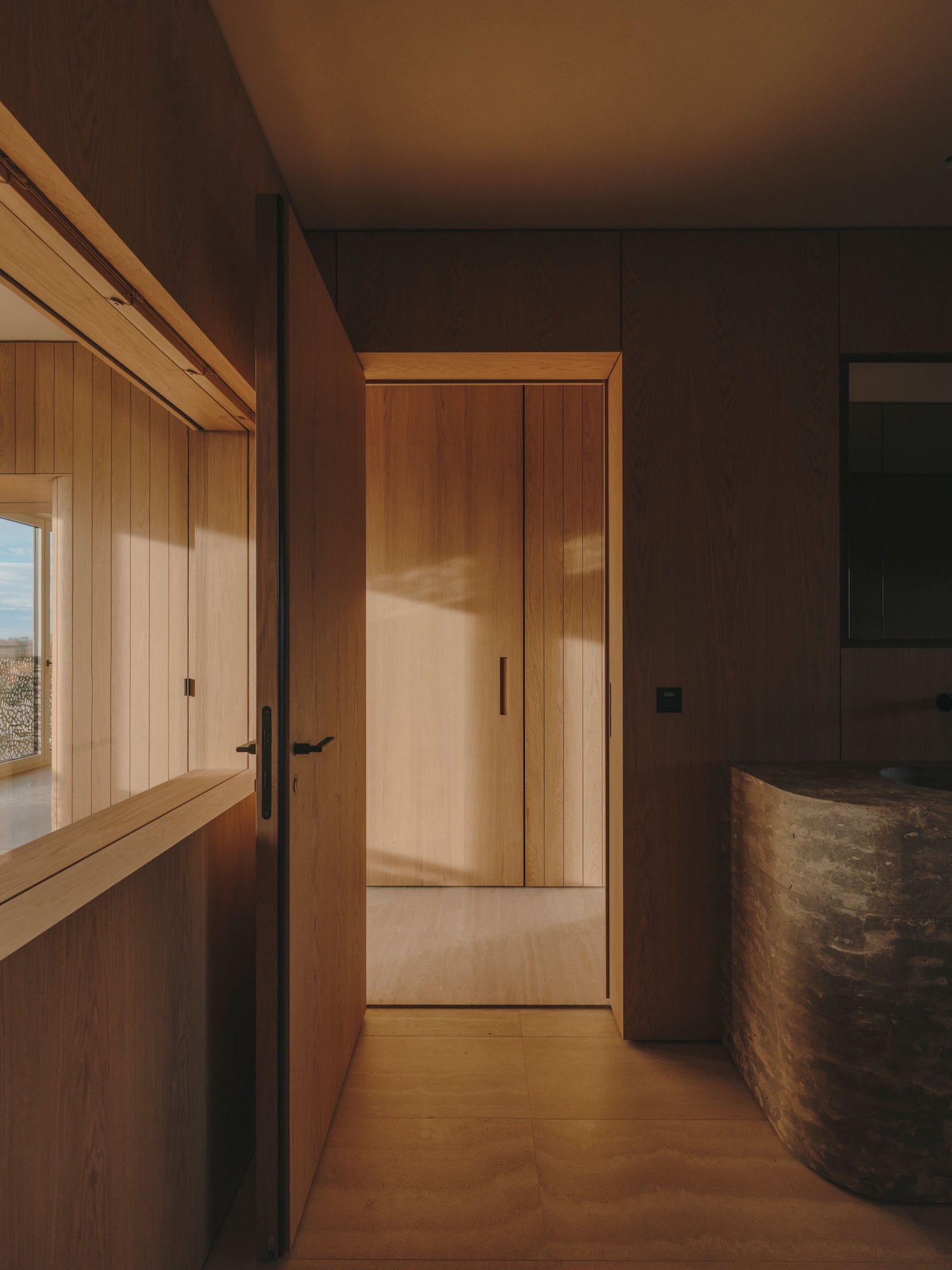
The master bathroom exemplifies the studio’s spatial strategy, positioned between two bedrooms with sliding panels that modulate light penetration deep into the floor plan. This configuration addresses the persistent challenge in open-plan living where bathrooms typically become isolated dark volumes. Here, natural light travels through the space while privacy remains controllable, a technical solution that also reinforces the apartment’s fundamental flexibility.