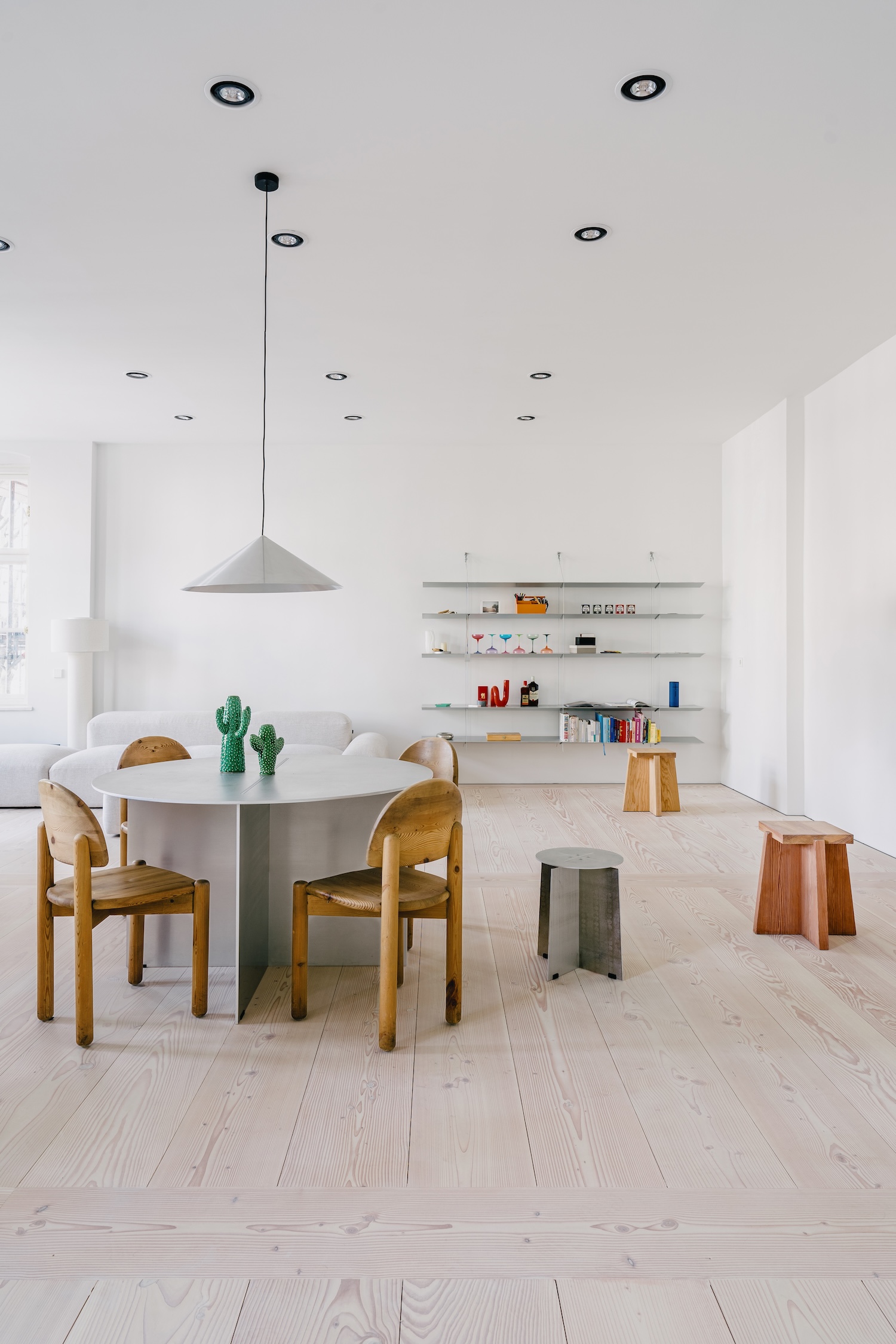
PROMM is a minimalist interior renovation located in Berlin, Germany, designed by STUDIO LOES. Berlin’s older building stock presents a particular kind of design problem. Decades of incremental renovation layer contradictions into floor plans – walls moved, rooms merged, proportions lost to piecemeal decision-making. The 77-square-meter Neukölln apartment that Studio Loes transformed under the name PROMM arrived with exactly this condition: a bathroom claiming an outsized share of the plan, rooms distributed without logic, and the architectural memory of removed partition walls still legible in the flooring beneath.
Rather than erasing these traces, Studio Loes read them as information. The studio, founded in Berlin in 2017 by Gonzalo Lizama, Onur Özdemir, and Lukas Specks, has built its practice around what it calls leftovers – the residual conditions of existing buildings that most architects treat as obstacles. In PROMM, that methodology finds one of its clearest expressions.
The Douglas fir floor by Dinesen carries the central design idea. Planks run parallel to the window axes throughout the open living area, but wherever a partition wall once stood, the boards shift to a crosswise orientation. The floor becomes a document of the apartment’s history – the spatial logic of a previous era made permanently visible through the grain direction of the wood. It is a restrained intervention, but one that rewards attention: the material record of two floor plans occupying the same surface.
Reconfiguring the bathroom drove the most significant spatial change. Studio Loes relocated it to the area farthest from the windows, abandoning any attempt to simulate natural light. The room leans into its condition instead, with Marbre Belleville stone surfaces, Appiani Pastelli Osso tiles carried across an unbroken wall, and a drain reduced to a single small square set flush with the floor. Fittings by Vola and Zazzeri hold the same suppressive logic – nothing surfaces that does not need to. The effect reads less as a bathroom and more as a material study in controlled enclosure.