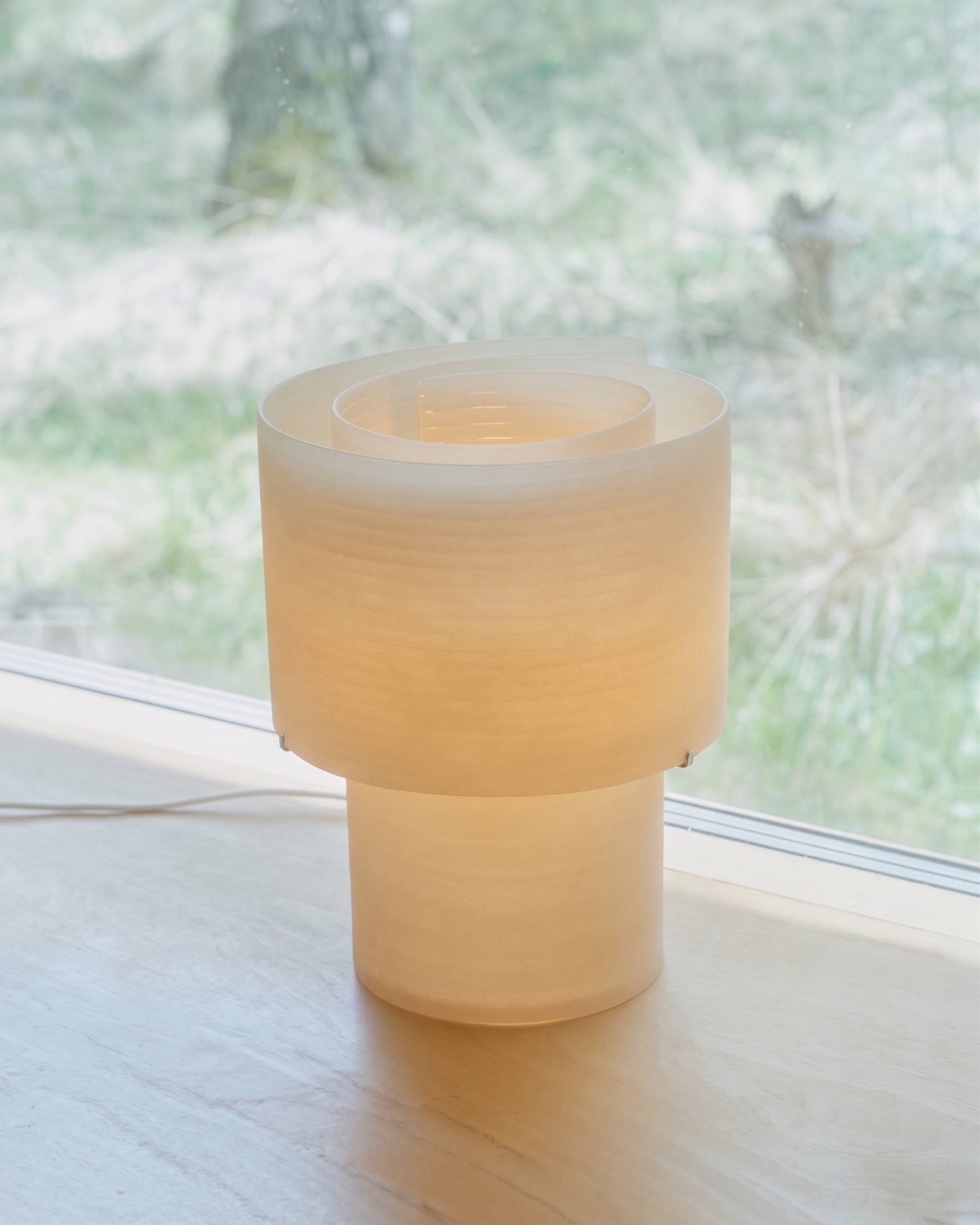
The color in each Snegl lamp comes from the shell itself. Seashells collected from restaurants are cleaned, ground, and compounded with a biopolymer before they ever reach the printer at RUSSO BETAK. The resulting biomaterial is what forms Snegl, a table lamp from the debut Ark collection by the Copenhagen, Denmark studio of Brazilian designer Stefannia Russo and Danish designer Søren Betak.
Most 3D printing builds an object upward in thin horizontal layers until the finished form stands complete on the print bed. The printer RUSSO BETAK built for its own use takes its logic from bentwood instead, where a straight length of timber is steamed and bent into a curve after it is cut. The machine lays down flat sheets of biomaterial, and the shape is decided afterward by hand. The printer is responsible for the sheet, and the hands are responsible for the volume.
Snegl, Danish for snail, was one of the studio’s earliest tests of that method. A single flat sheet is rolled by hand into a coil, turning a two-dimensional surface into a volume with no curvature printed into it. Light from a warm-white LED passes through each successive turn of the translucent sheet, and the spacing between the turns sets the rhythm of the glow. Every layer diffuses the light a little further, so the lamp produces a soft ambient wash that fills the surrounding space.
The three versions of Snegl are named for the shells that color them. Scallop yields a soft off-white, Mussel a warm peach beige, and Oyster a muted olive brown. No dye is added. Because the ground shell is compounded into the biomaterial itself, the color runs through the full thickness of every sheet, and the lamp carries it from within once it is switched on.


