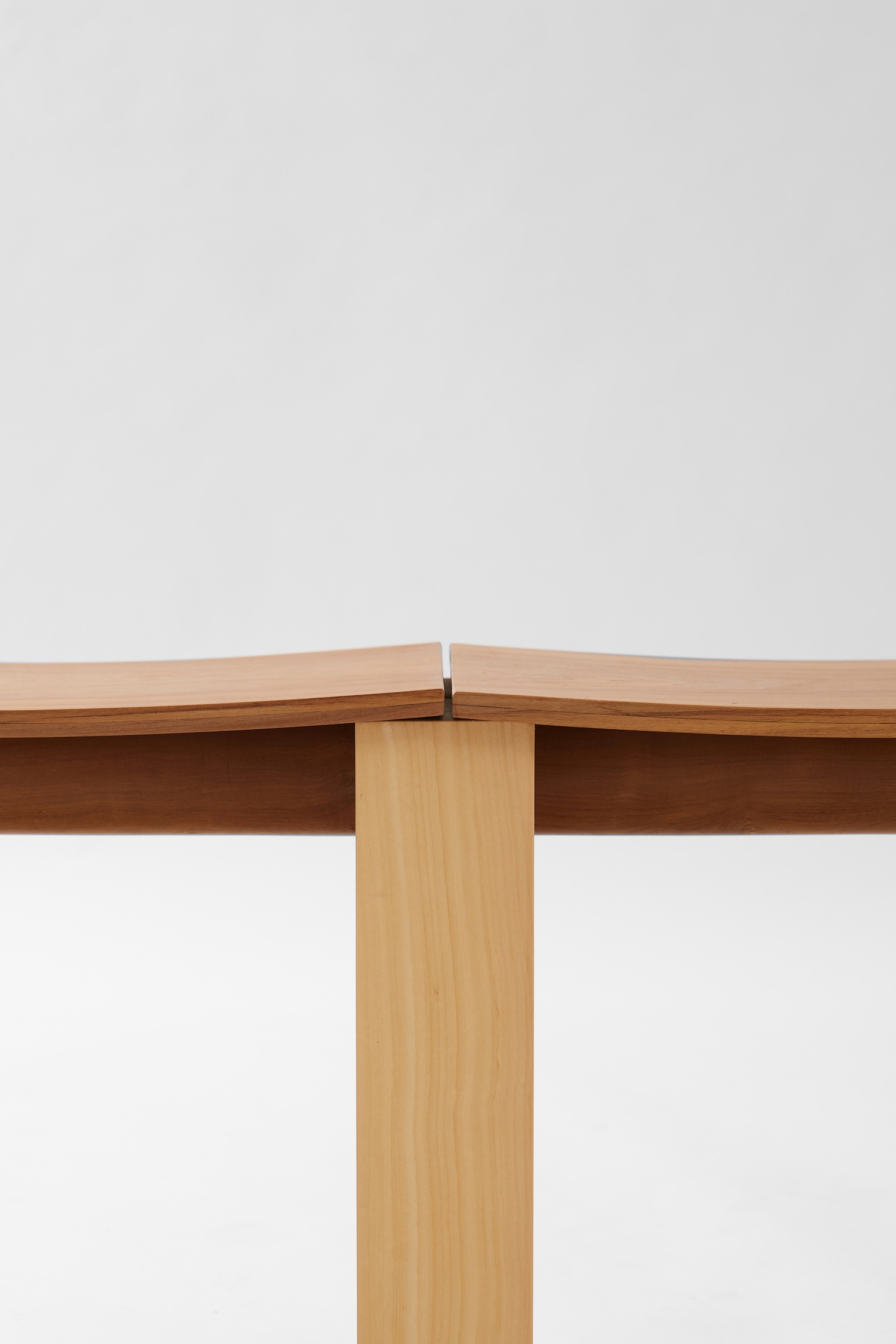
Banco Doble Tronco is a minimalist seat designed by Buenos Aires-based studio Taller Posible. The three-inch guatambú framework stands like architectural poetry, its substantial presence commanding attention without aggression. Here, the designer has made a bold decision that reverberates through contemporary furniture making – to celebrate rather than conceal the joinery. Each visible connection becomes a moment of truth, revealing not just how the piece comes together but why it chooses to announce its construction so boldly. This transparency echoes the radical honesty of early Arts and Crafts pioneers, yet speaks in an entirely modern vernacular.
What makes this piece particularly compelling is its sophisticated dialogue between geometric precision and organic warmth. The straight lines of the guatambú create a structural grid that recalls the rational clarity of mid-century modernism, but the circular crossbeam disrupts this geometric order with deliberate grace. This turned element, crafted from incense wood, introduces a vocabulary of curves that the eye follows instinctively, creating visual rhythm within the otherwise linear composition.
The material conversation grows richer still with the curved seat, another incense wood element that transforms the sitting experience from functional to sensual. The warm tones of this secondary wood do not merely contrast with the guatambú – they create a chromatic narrative that speaks to the biodiversity of Argentine forests. Each species brings its own character to the conversation, the incense wood’s aromatic qualities adding an almost synesthetic dimension to the design experience.
This chair emerges from a contemporary moment when makers are increasingly questioning the industrial impulse to hide process and material truth. The visible joinery connects to a broader movement in contemporary craft where technique becomes ornament, where the how of making enriches rather than compromises the final form. We see echoes of this philosophy in the work of studio furniture makers from George Nakashima to contemporary practitioners who celebrate wood’s natural properties alongside human skill.