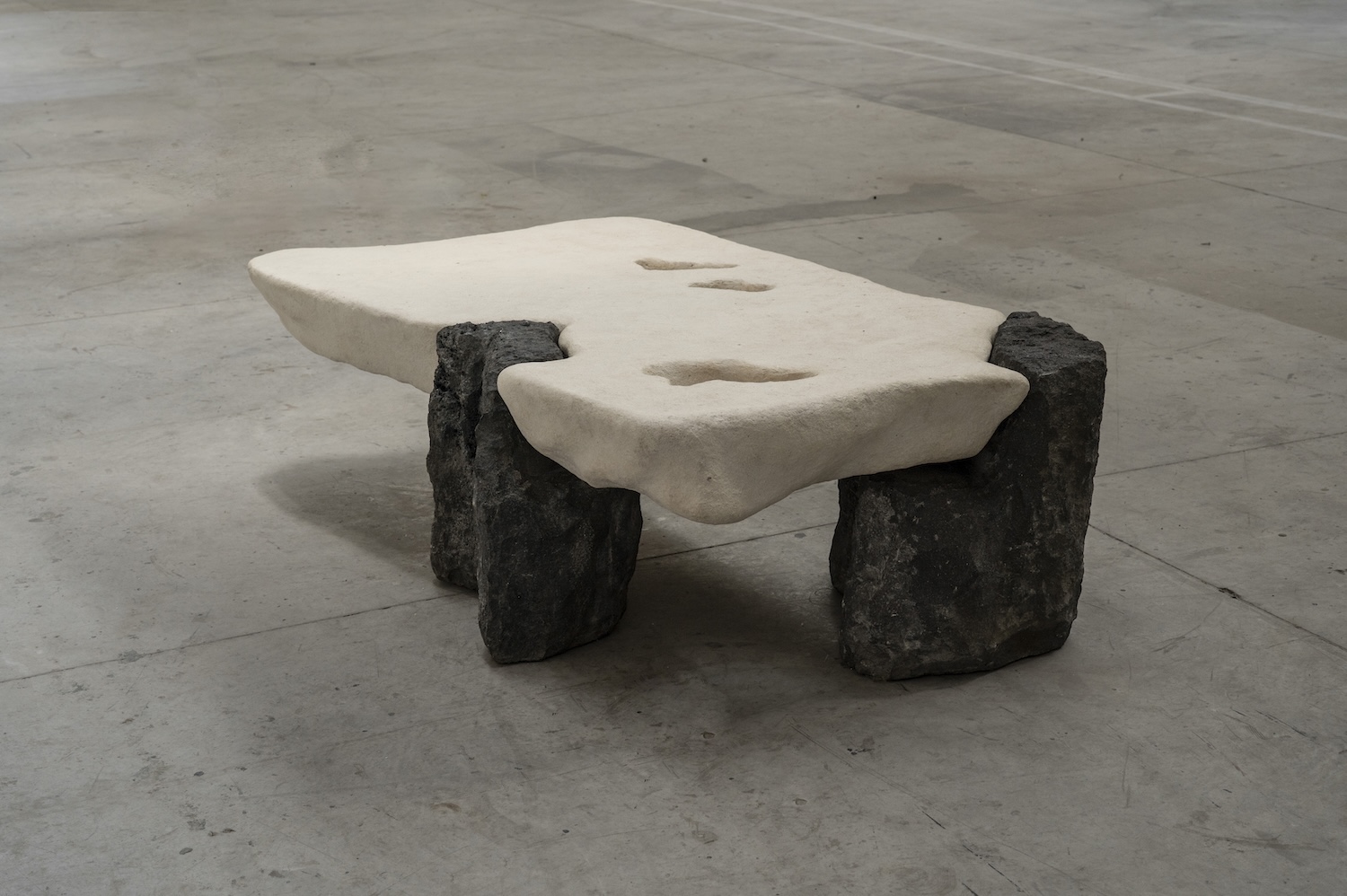
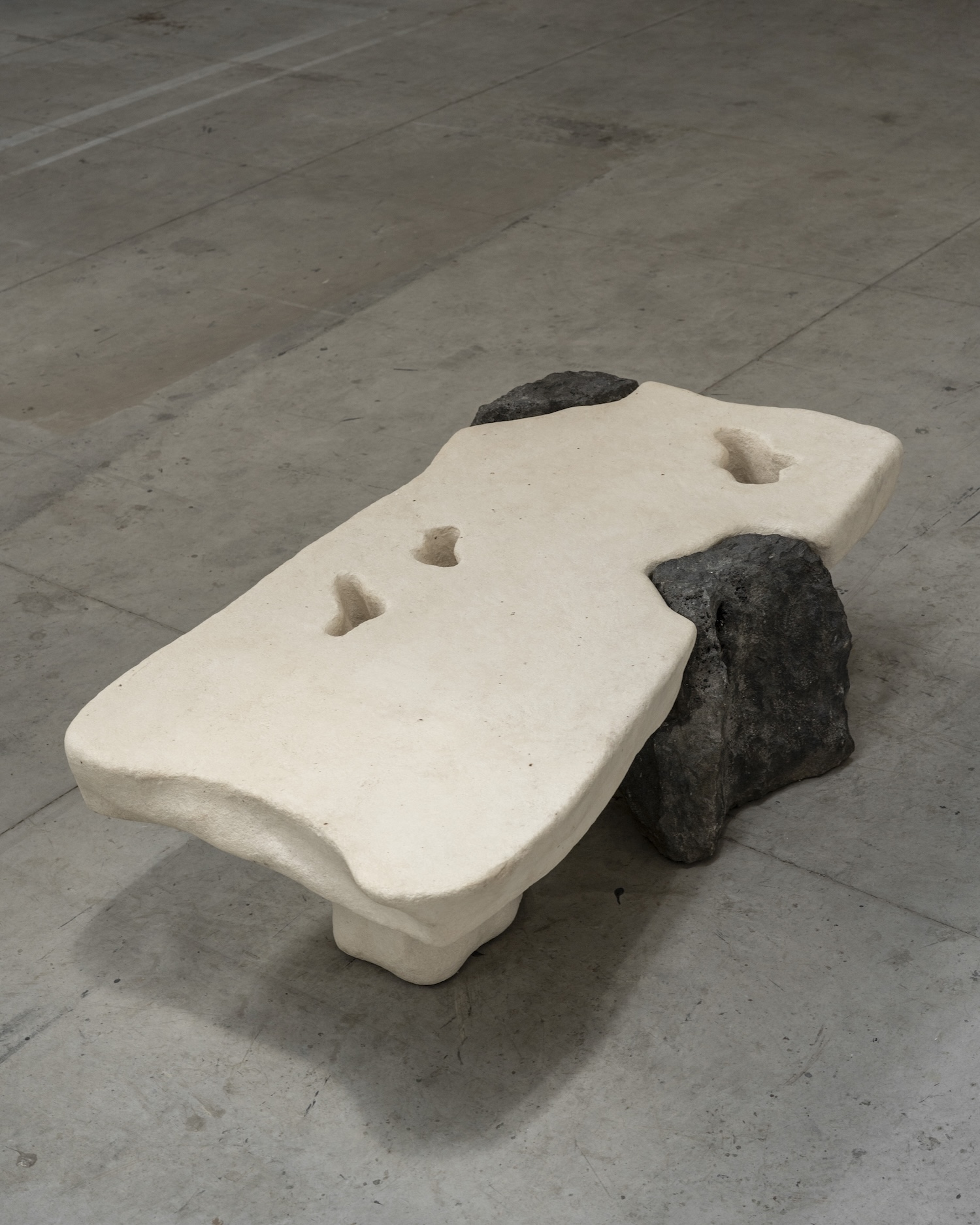
Mictlán Low Table is a minimalist sculptural table designed by New York-based practice Robert Marinelli. Few materials carry geological memory as literally as volcanic stone – formed under extreme pressure, cooled over millennia, and bearing the textural record of its own violent origins. Pairing it with cartonería, a material built up from organic fibers that will eventually decompose back into the earth, creates a tension that is less about contrast for its own sake and more about encoding a full life cycle into a single object. The Mictlán Low Table operates in this space between permanence and impermanence, drawing on Mesoamerican mythology to reframe what a piece of furniture can carry beyond its functional role.
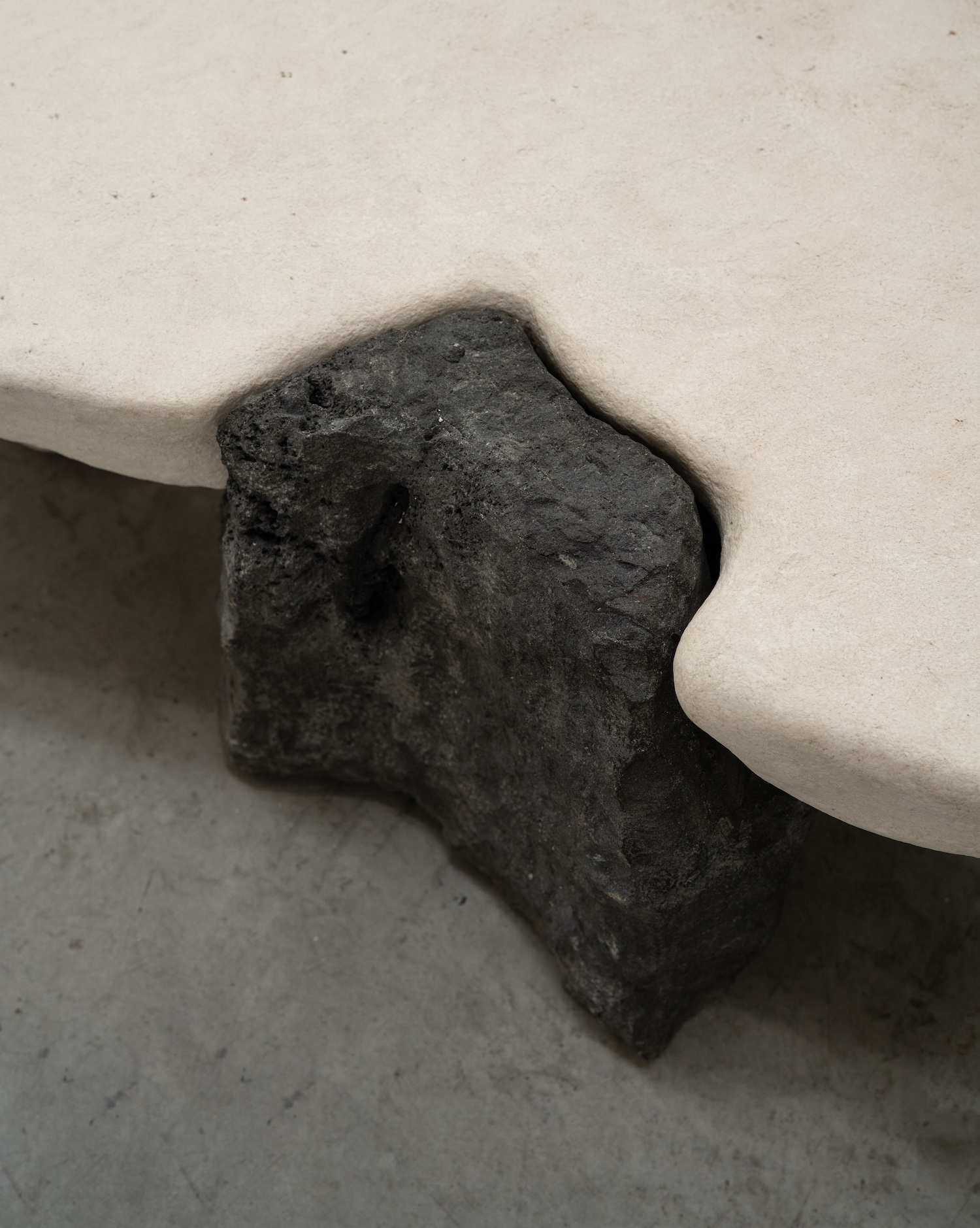
The table emerges from Marinelli’s broader Mictlán Collection, a body of work rooted in the Mexica creation narrative in which the goddess Cihuacóatl descends into the underworld, gathers the bones of previous civilizations, grinds them, and buries them to give rise to new life. That cycle of descent, fragmentation, and regeneration is not applied as surface decoration but embedded in the material logic of each piece. The low table makes this legible through its tripartite base structure – two legs chiseled from volcanic stone and a central leg formed in cartonería. The asymmetry is deliberate. Weight pools at the periphery while the organic core holds the center, a structural inversion that echoes the myth’s insistence that life emerges from the lightest, most perishable matter.
Cartonería as a furniture-making material is almost unheard of in contemporary design. The technique, traditionally associated with Mexican festival figures and alebrijes, involves layering moistened paper and natural fibers over armatures to build form through accretion rather than subtraction. Marinelli’s use of it here recalls the experimental material investigations of designers like Fernando and Humberto Campana, who similarly elevated vernacular craft processes into high-design contexts, though the Mictlán work operates with a more restrained, almost archaeological sensibility. The cartonería surfaces are left largely unfinished, preserving the visible texture of fiber and adhesive – a decision that reinforces the collection’s ecological position. These are materials designed to return to the ground.