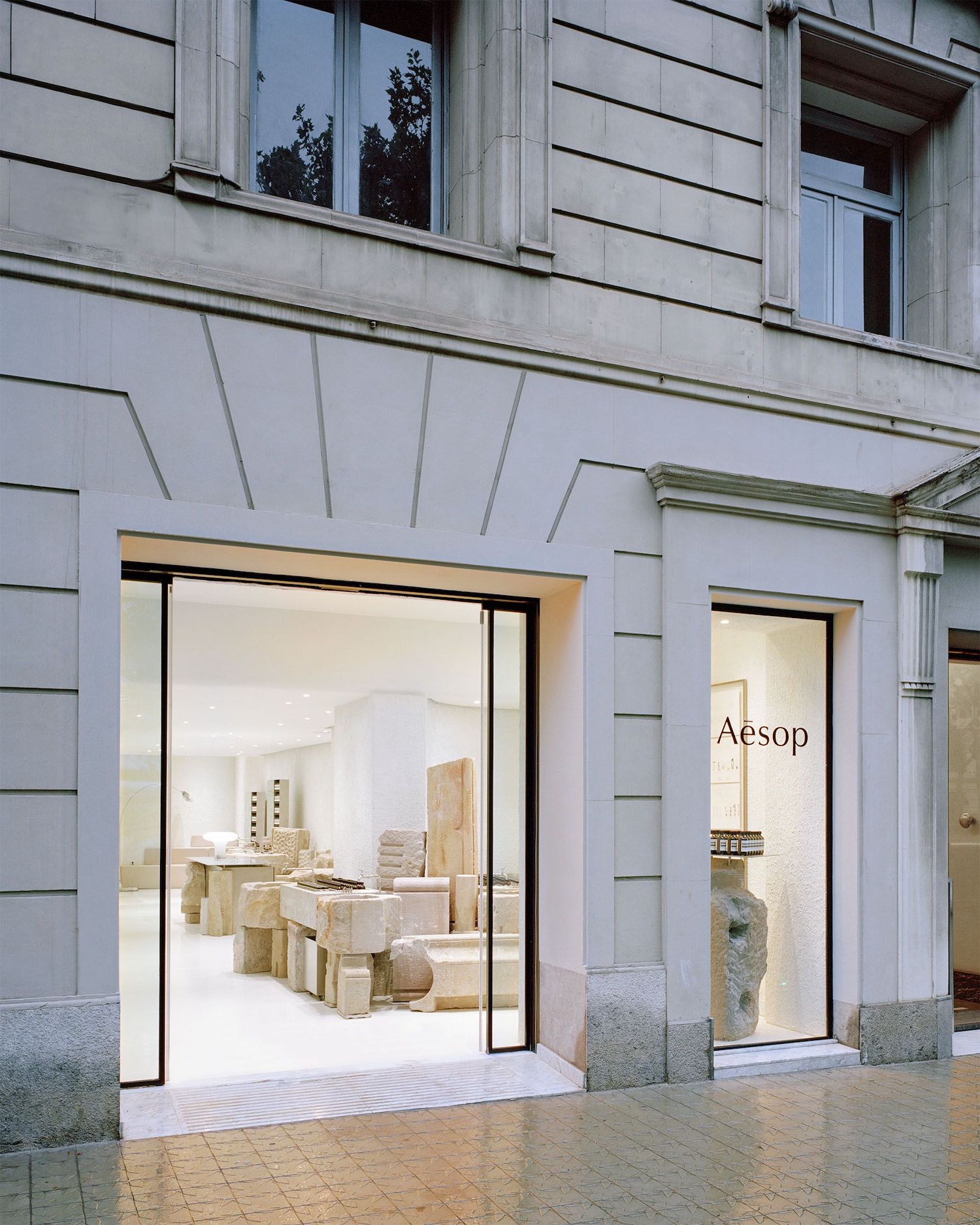
Aesop Diagonal is a new store located in Barcelona, Spain, designed by mesura. This project prominently features Montjuïc stone from the local quarry, reflecting a resistance to the homogenizing effects of globalization in the retail industry. In 2022, Aesop enlisted a design team to create their second Barcelona location, initially planned for a modernist building on Rambla Catalunya. Although this site became unavailable, the brand’s vision of a space that extends beyond mere aesthetics to resonate deeply with the public remained steadfast. Aesop’s vision encompassed creating a space that was social, timeless, and local, with an additional emphasis on sustainability. To cultivate a social atmosphere, the design team explored Barcelona’s history of public fountains. For a timeless appeal, they chose stone for its unmatched durability.
They committed to using only local stones to ensure the project’s sustainability and long-term purpose. The team faced challenges in sourcing reusable materials, initially attempting to repurpose stones from the Sagrada Familia. Eventually, they discovered an old quarry holding remnants of demolished Barcelona buildings constructed with Montjuïc stone. This unique, city-specific stone proved to be an ideal choice. Partnering with the Barbany family, renowned stonemasons with a 130-year legacy, the project tapped into a deep well of local heritage. The Barbanys had preserved fragments of nineteenth-century buildings, occasionally using them as testing grounds for new quarrying tools. Through diligent effort, the team uncovered pieces from Gothic quarter structures, ancient fountains, archways, and pedestals.
One visit to the Barbany workshop confirmed that they had found the perfect materials. These stones would become the central feature of the store, particularly around the sinks where customers engage with Aesop’s products. The rest of the store maintains a neutral backdrop, allowing the stone ensemble and products to take center stage. Constructing Aesop’s store required a unique approach, starting with selecting and arranging 78 stones before finalizing the design. Cataloging each stone, the team initially attempted precision assembly but soon shifted to a hands-on, trial-and-error method, building a model at the Barbany workshop. The complexity of assembling these stones in the confined space of Avinguda Diagonal became evident.
For three weeks, the team practiced handling the stones with the care typically reserved for delicate glass. After numerous tests, the mock-up was validated, and the stones, now numbered and strategically palletized, were ready for final assembly. The store’s design highlights the beauty of the stone within a minimalist framework. Textured stucco walls, a sleek floor finish, and a refined stucco ceiling create a contrast between the lightness and delicacy of the store’s interior and the density and weight of the stone. Stainless steel elements add functionality and complement the stones’ aesthetic. The design process was dubbed ‘Creative Anastylosis,’ a term borrowed from the Greek practice of reconstructing ancient monuments from their fragmented parts. This approach flips the conventional design process, starting with available materials to create something entirely new.