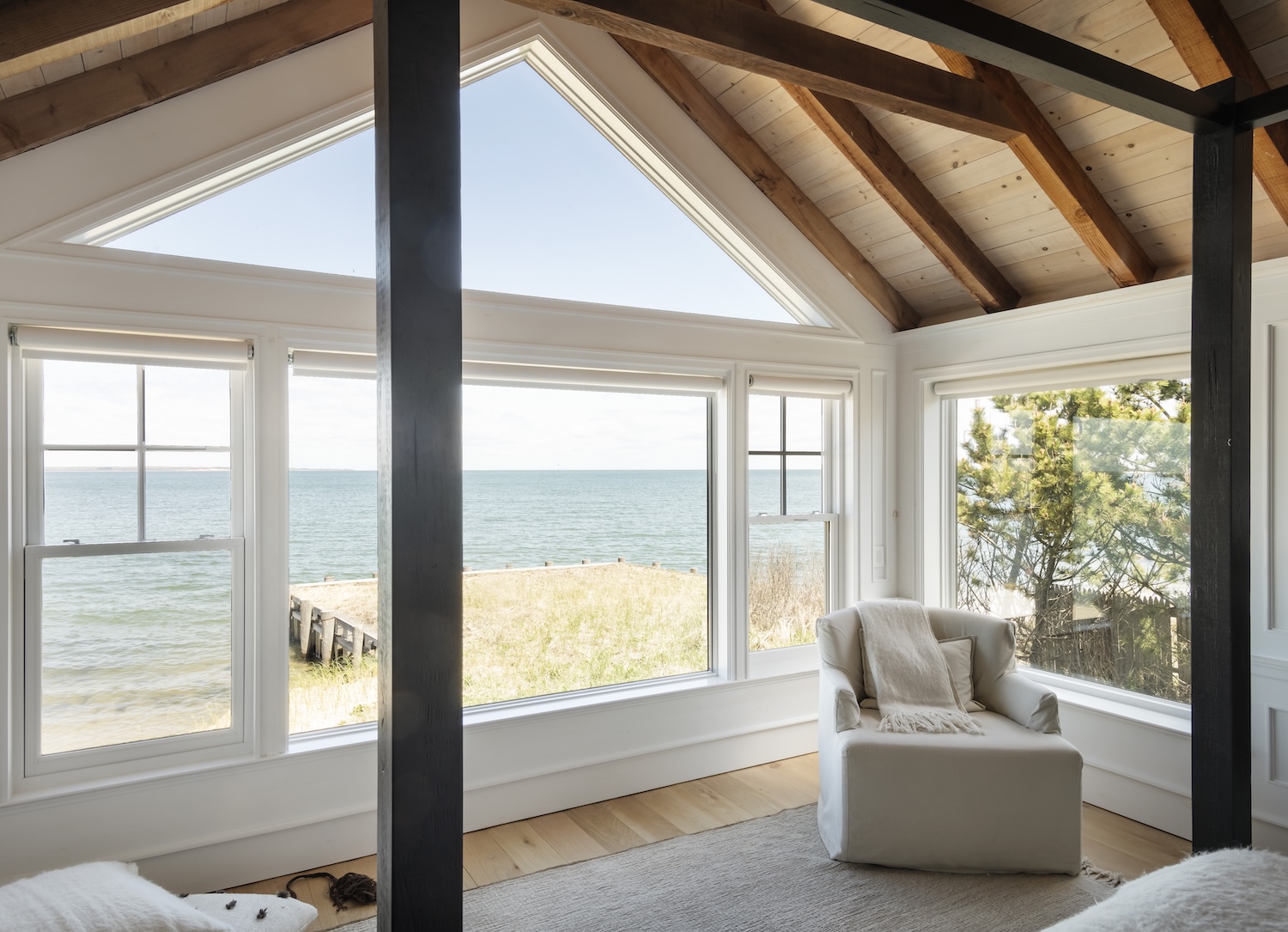
Amagansett Bay House is a minimal home located in Amagansett, New York, designed by Amalia Graziani of Noor Property Group. In the weathered patina of reclaimed driftwood, Graziani discovered not decay but possibility – a material narrative that would define an entire design philosophy. When the designer first encountered that storm-battered cottage in Amagansett, the very elements that others might dismiss as deterioration became the foundation for a profound meditation on place, time, and craft.
The transformation that followed reveals design thinking at its most sophisticated: a careful choreography between preservation and innovation that speaks to broader questions about how we inhabit landscapes shaped by both human history and natural forces. Graziani’s approach – sourcing all materials within the immediate vicinity – might initially seem like a quaint localism, but it represents something far more radical: a rejection of the globalized material palette that has homogenized so much contemporary design.
Consider the raw oak paneling that wraps the great room walls. Left unfinished, the wood bears the honest marks of its processing, each grain line a record of growth rings and seasonal change. This material choice aligns with a broader movement in contemporary craft toward what we might call “material honesty” – a philosophy that celebrates rather than conceals the inherent properties of substances. The technique recalls the Shaker tradition of allowing wood to speak for itself, yet the execution feels thoroughly contemporary in its restraint.
“I wanted the house to feel like it had always been here,” Graziani explains, “but also to acknowledge that we’re making something new.” This tension – between continuity and innovation – manifests most powerfully in the interplay between salvaged beams and modern furnishings. The chrome fixtures and angular silhouettes create what design theorists call “productive friction,” moments where different temporal registers meet and generate new meanings.
The hand-applied plaster work demonstrates another dimension of this material thinking. In an age of increasingly mechanized construction, the visible evidence of human touch in these creamy surfaces connects to ancient traditions of lime rendering while serving thoroughly modern spatial needs. Each imperfection becomes intentional, a celebration of the artisan’s hand that recalls Bernard Leach’s philosophy of embracing the “accident” in craft.