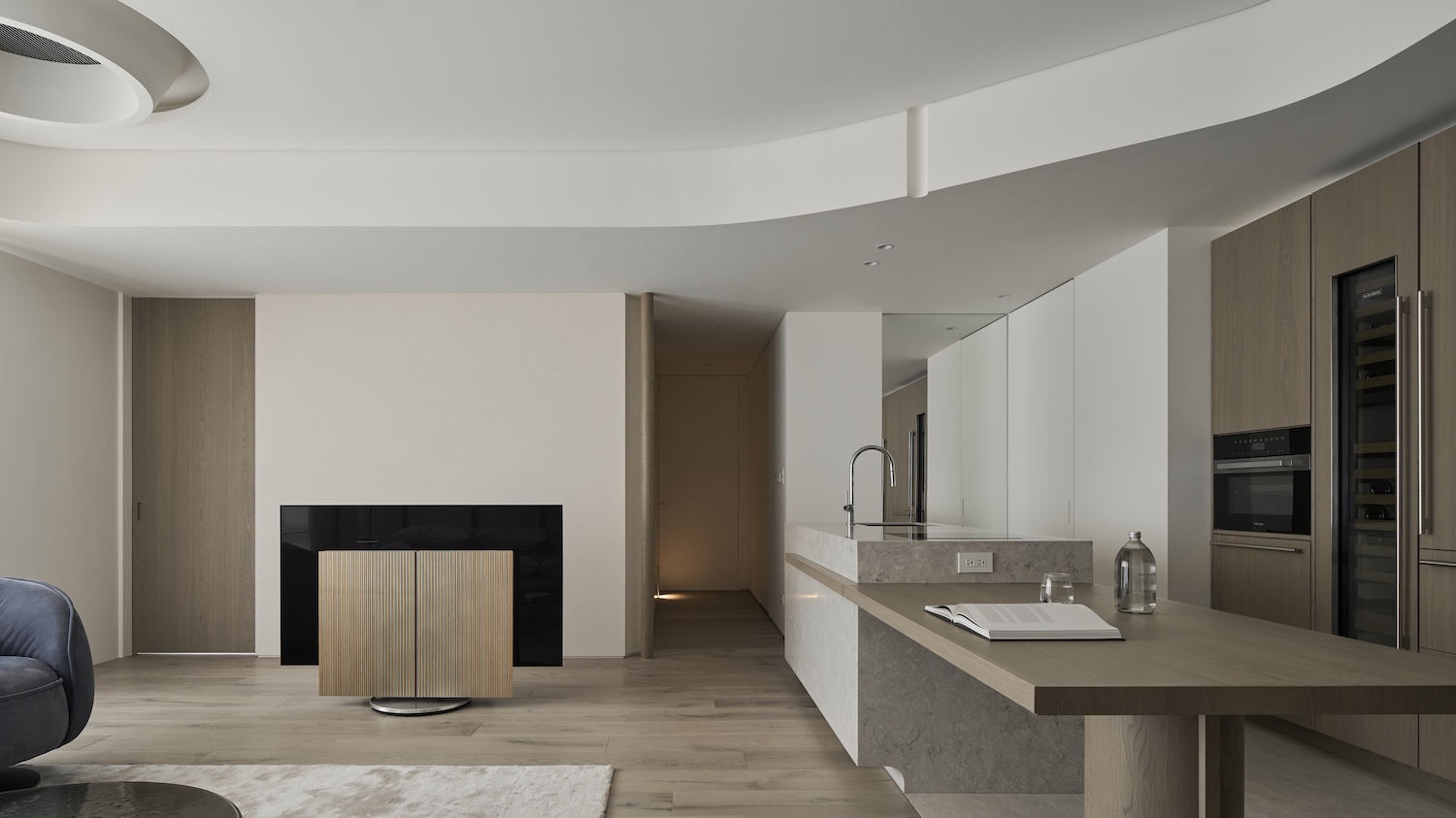
The Pinnacle is a minimalist residential interior located in Taipei City, Taiwan, designed by Republic Design. Thirty square meters along the Danshui River presents a specific problem: the view is the asset, and almost every conventional layout decision works against it. Republic Design resolved this by stripping circulation back to its minimum and refusing the standard Taiwanese apartment hierarchy of a television wall anchoring the living room. Without that organizing fixture, the public zone – living, dining, kitchen – collapses into a single continuous field. The spatial logic follows the client’s life rather than convention; her daughter lives abroad long-term, so the apartment needed to read as one expansive room rather than a sequence of defined uses.
The material palette keeps deliberate distance from itself. Metalwork throughout the public areas stays thin and recessive, a conscious decision to let the furniture carry the visual weight. This is a curatorial approach to interior architecture – the space functions as a neutral armature for the owner’s collected objects and taste rather than competing with them. Pastel tones in the master bedroom and marshmallow-density textiles shift register completely, with purple-carved stone and bronze metalwork threading through into the master bathroom to sustain the chromatic logic without repeating it.
The most considered move in the project is the translation of the owner’s passion for jazz drums into spatial elements. The saucer-profile circular air vents and rippled recessed ceiling details in the dining area are not decorative gestures applied after the fact – they encode the physics of sound into the ceiling plane. Ripple patterns reference the visual record of a drum strike, the concentric interference pattern that percussion produces in any resonant membrane. This is a relatively rare approach in Taiwanese residential work, where cultural reference tends toward calligraphy or ink-wash painting; the decision to draw on jazz – an imported, improvisational, rhythmically complex form – says something deliberate about the client’s self-conception.