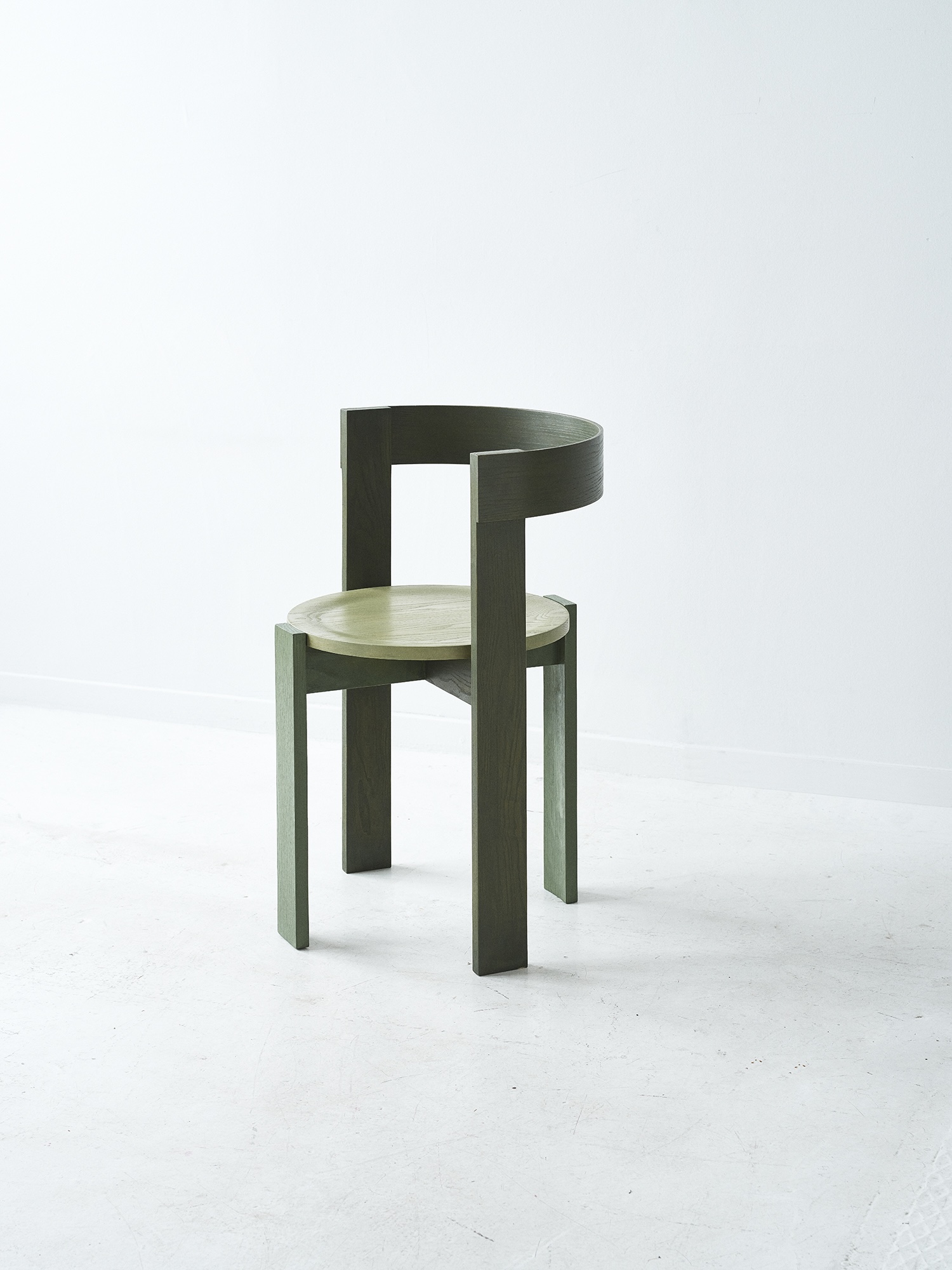
Stack enough Børsstolen chairs and the column begins to read as the twisted spire of Børsen, the fire-damaged building in Copenhagen that served as the design’s point of departure. The chair is by Laura Kjær Studio, a one-woman design practice based in Aarhus, Denmark, and its geometry is drawn directly from the rounded forms of the Børsen facade.
A single chair carries those curves at furniture scale. The spire only appears in multiples. Stacking is usually treated as a storage function, and most stacking chairs are shaped to disappear into a compact, anonymous pile. Here the pile holds the second half of the architectural reference, and a stack left standing in a room shifts from a quantity of seating into something with the presence of a sculpture.
Color came from the building itself. Traces of historic green pigment found within the burned structure informed the chair’s palette, extending the life of tones that survived the fire into contemporary interiors. The frame is ash, a dense, straight-grained hardwood that takes paint evenly and holds up to the repeated handling a stacking chair receives.
A copper ornament on the chair is engraved in tribute to Sophie of Mecklenburg-Güstrow, who financed the original construction of Børsen. The engraving returns her role as one of Northern Europe’s most influential early patrons to the account of the building, placed on an object that will circulate far from Copenhagen.
The finish is linseed oil paint followed by beeswax. Linseed oil paint cures by oxidizing and penetrates the wood fibers, so wear shows as gradual thinning at contact points and can be touched up locally. Fresh coats bond to older ones without the surface being stripped back to bare wood, and the wax layer can be renewed as it wears. Together these allow the chair to be repainted and maintained by successive owners over generations.


