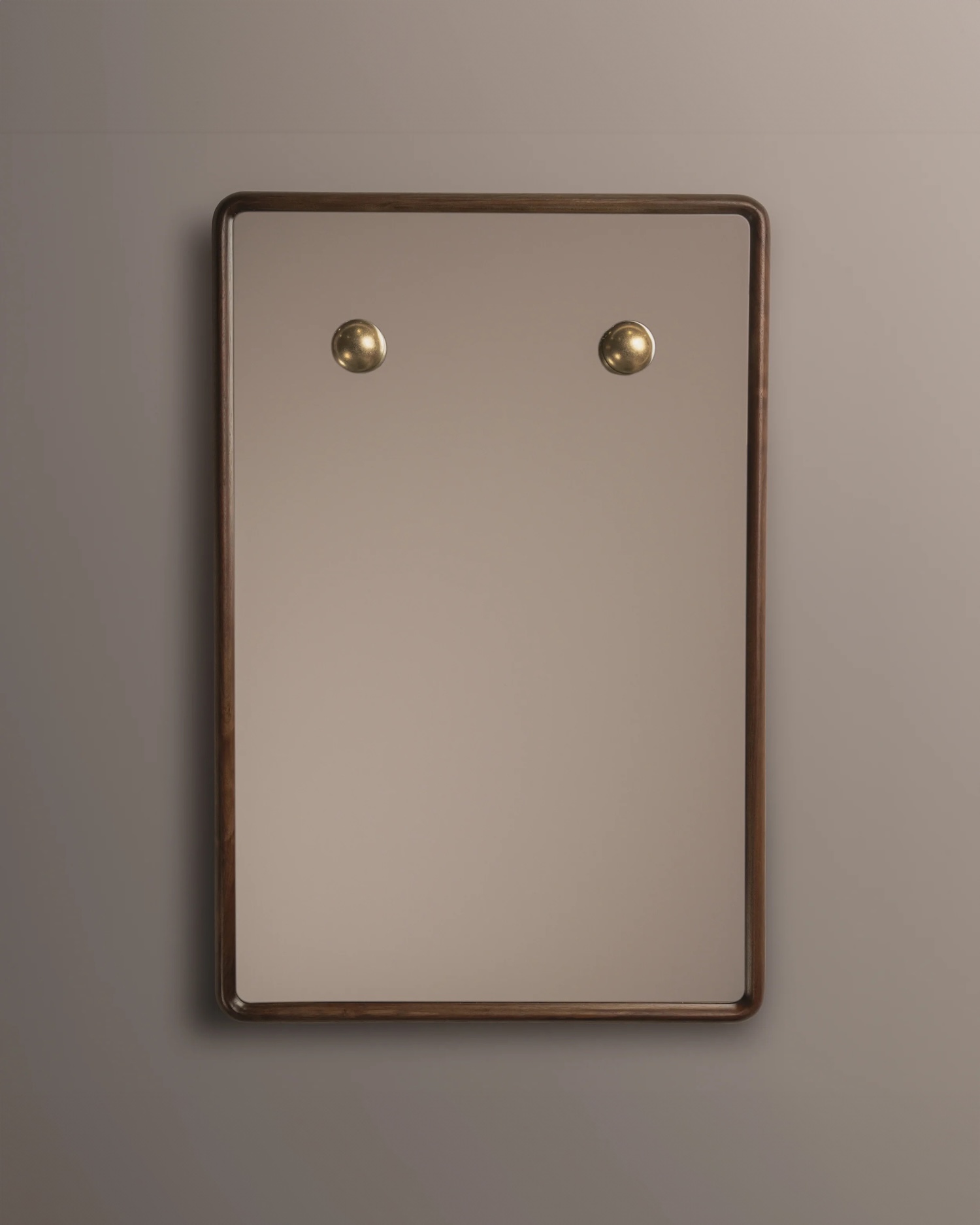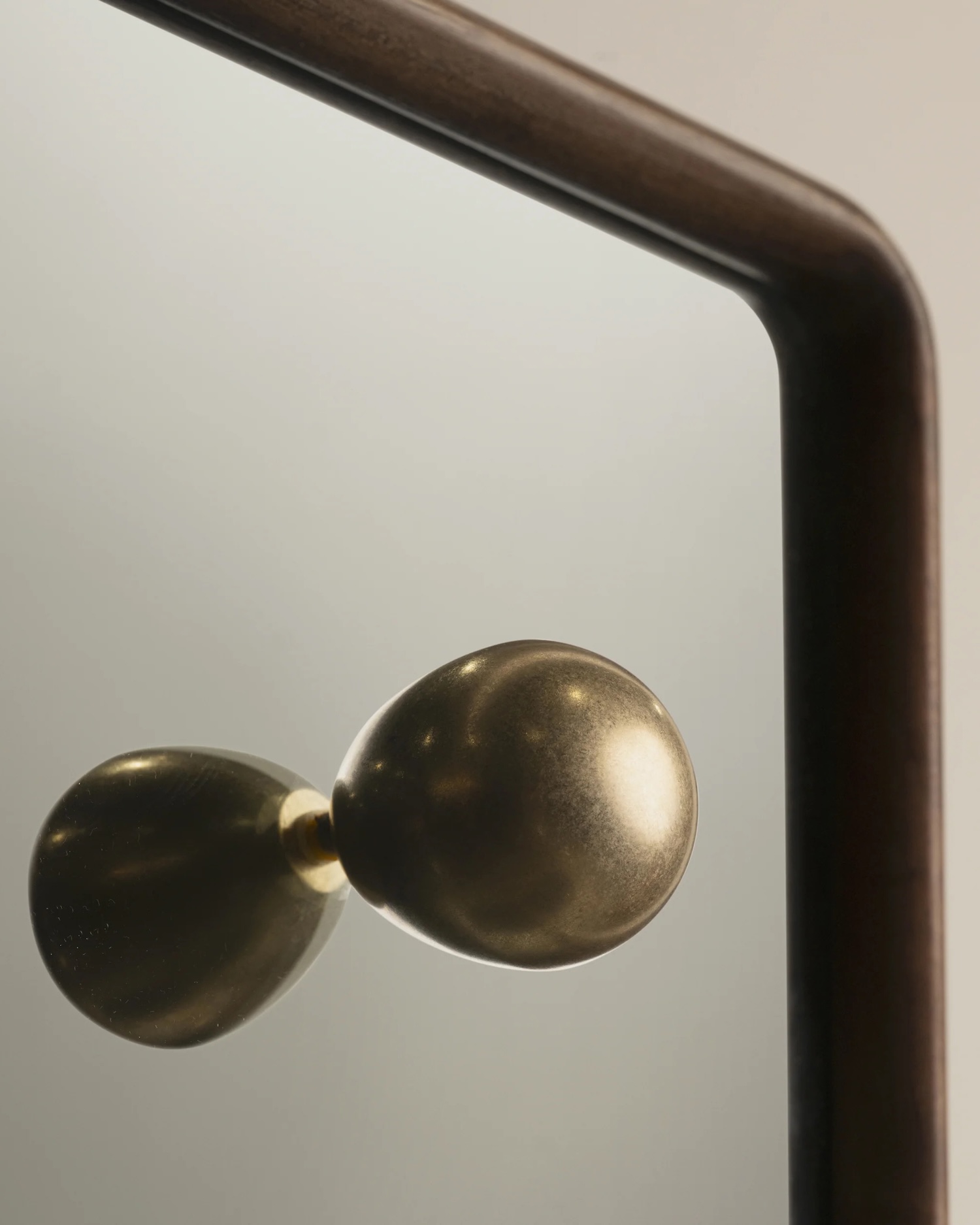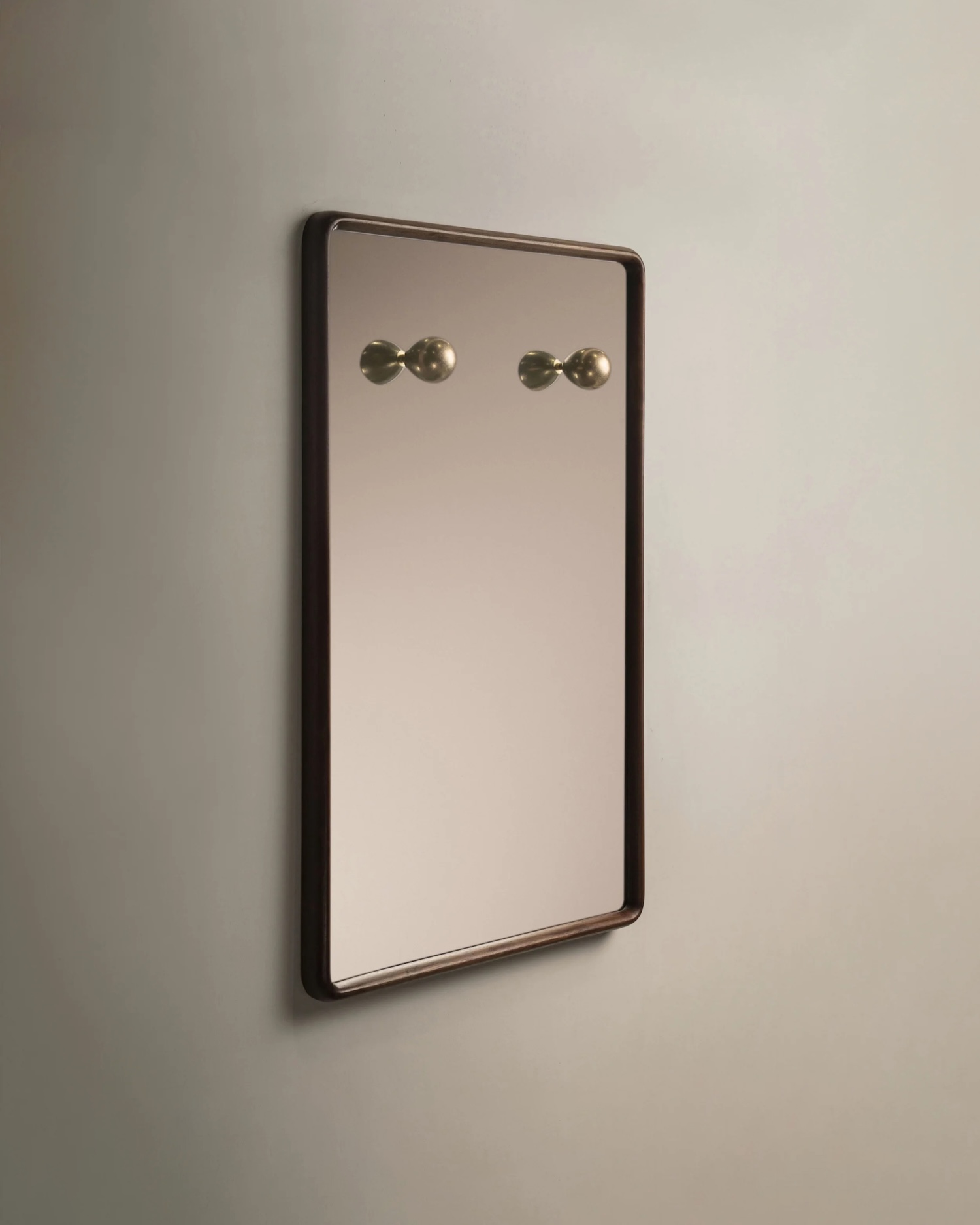
Knob is a minimalist mirror created by New York-based designer Jason Miller. The collection continues his long-running investigation into the point where utility and form converge, following the earlier Knot and Bend mirrors, and it treats the mounting hardware not as a concealed necessity but as the defining architectural element. Solid brass anchors, shaped like small eggs, pass directly through the glass to secure each mirror to the wall, and in doing so they establish a quiet visual rhythm across the reflective surface. What would ordinarily disappear behind the frame instead becomes the thing the eye returns to.
This inversion places Knob within a lineage of design that prizes the honesty of construction over decoration. There is a Shaker logic at work here, where a peg or a joint is allowed to remain visible because its function is already beautiful, and there is an echo of the mid-century impulse to let a fastener read as an ornament in its own right. The anchors become an integral part of the composition, offering a sculptural counterpoint to the mirror’s restrained geometry rather than interrupting it. Miller has effectively taken the least glamorous component of a wall-hung object and promoted it to the role of protagonist.
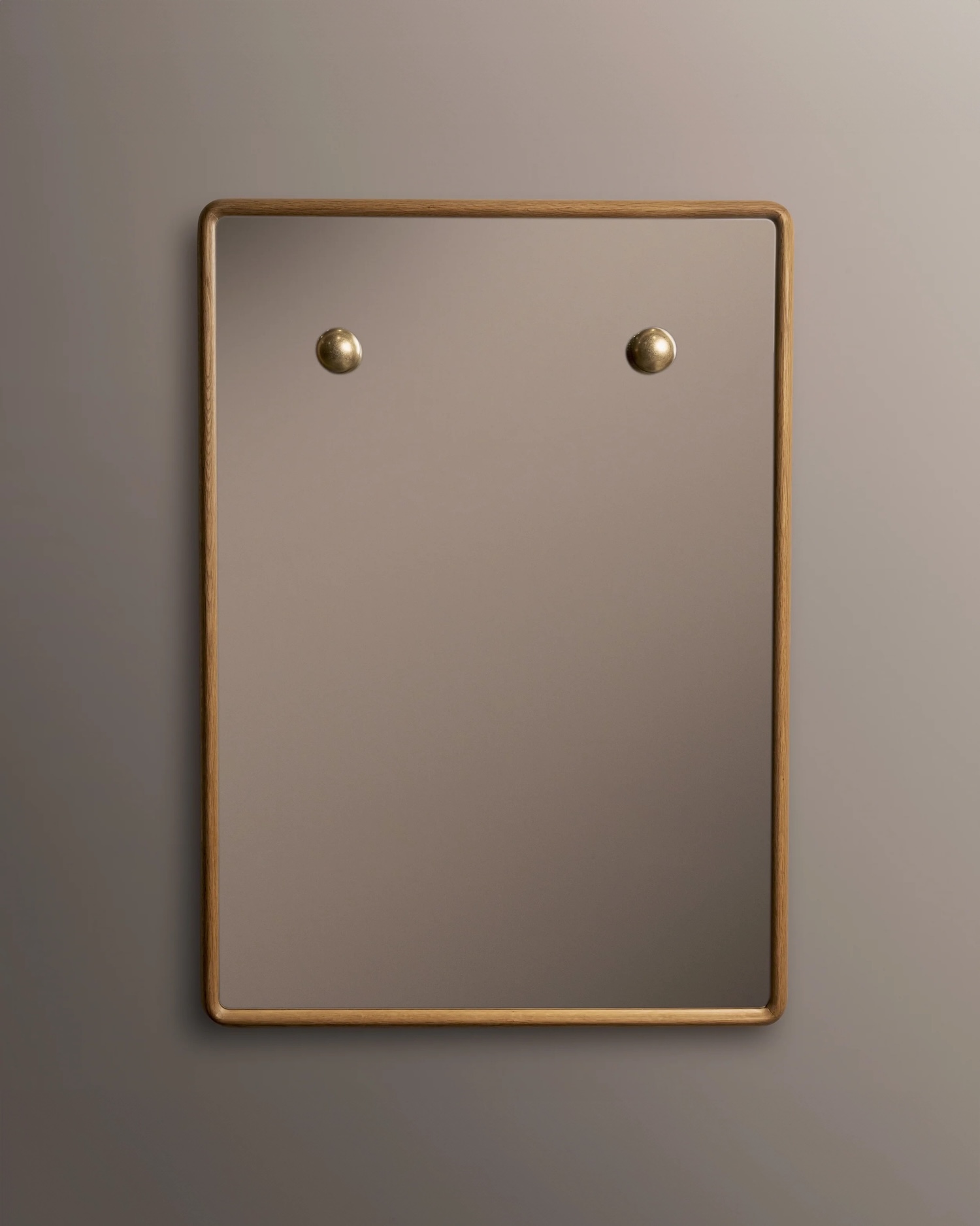
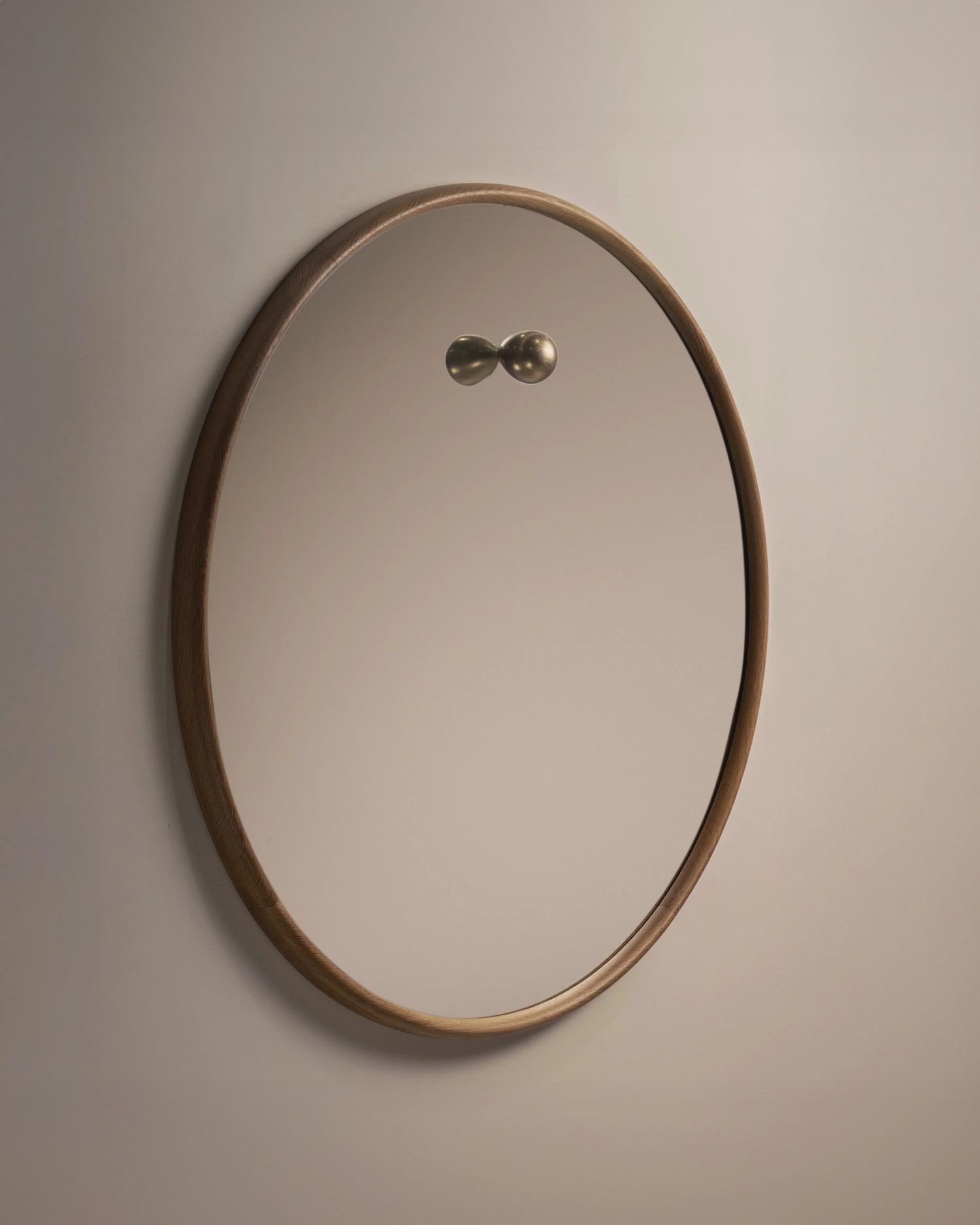
Available in circular and rectangular formats, each mirror is framed in black walnut, white oak, ebonized oak, or vintage oak. The thin timber profile establishes a quiet perimeter, allowing the proportions of the glass and the placement of the antique or polished unlacquered brass hardware to carry the design. That choice of unlacquered brass matters, because it is a material that refuses to stay fixed. Left uncoated, it oxidizes and warms with handling, so the mirror is never quite the same object a year after it is installed. The warmth of the wood already contrasts with the cool reflectivity of the glass, and the brass introduces a third register that develops character over time, giving the piece a slow, living quality.
Rather than relying on ornament, Knob is defined by reduction, and every element performs a purpose, from the exposed anchors to the continuous timber frame. The design expresses its construction openly, revealing how the mirror is assembled instead of concealing it. This transparency is the conceptual core of the collection. In an era where hardware is routinely engineered to vanish, Knob argues that showing how a thing is made can be its most compelling feature.