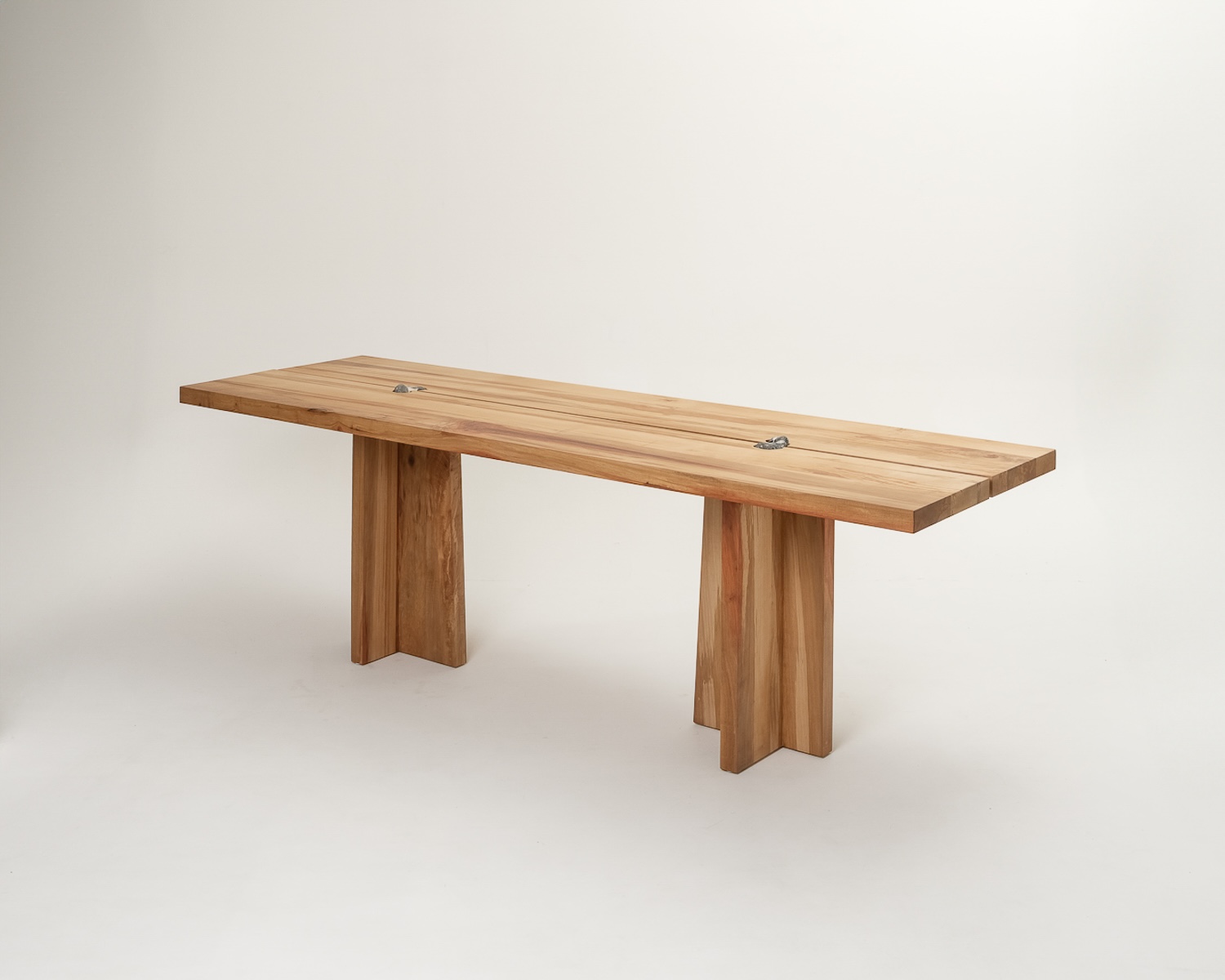
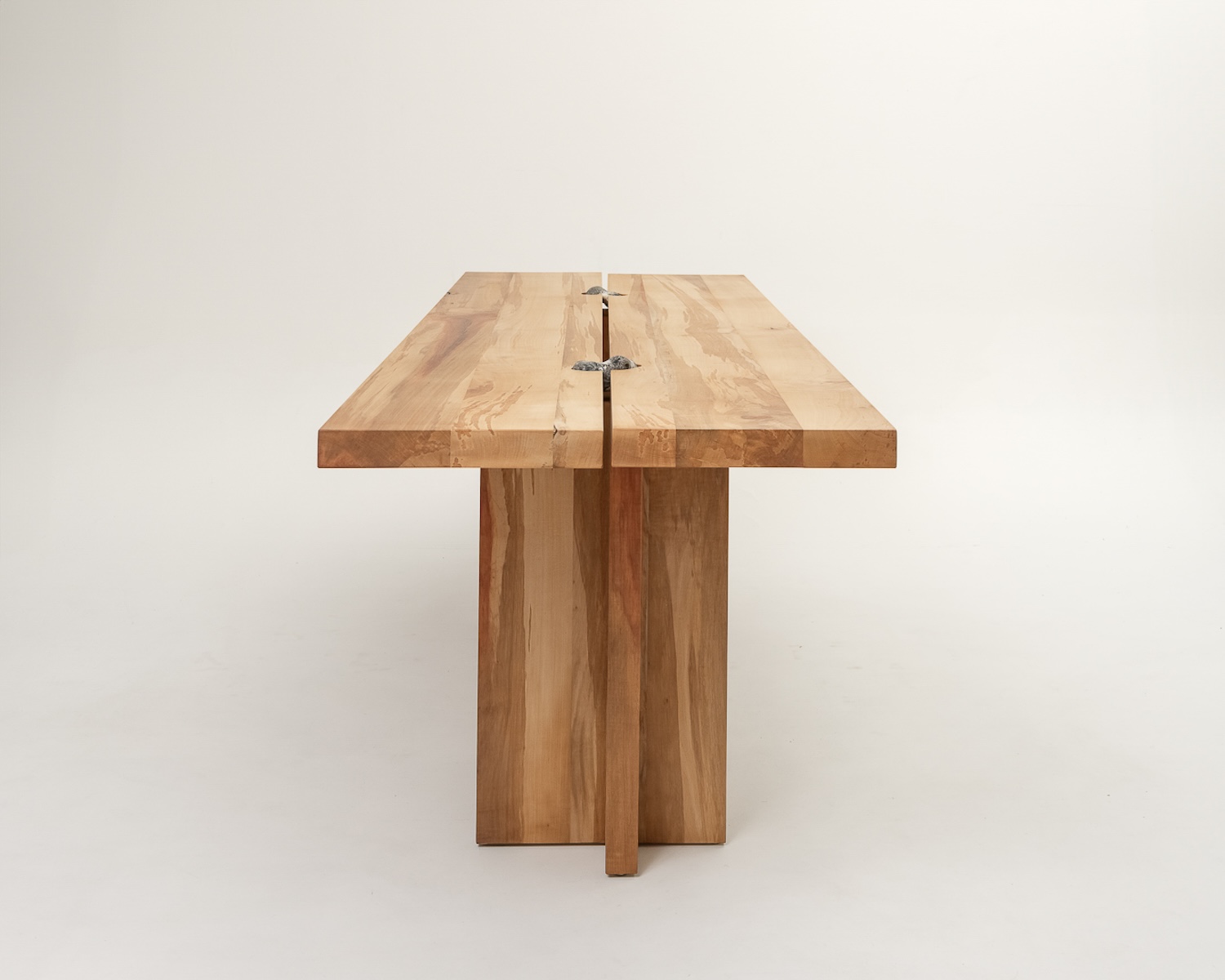
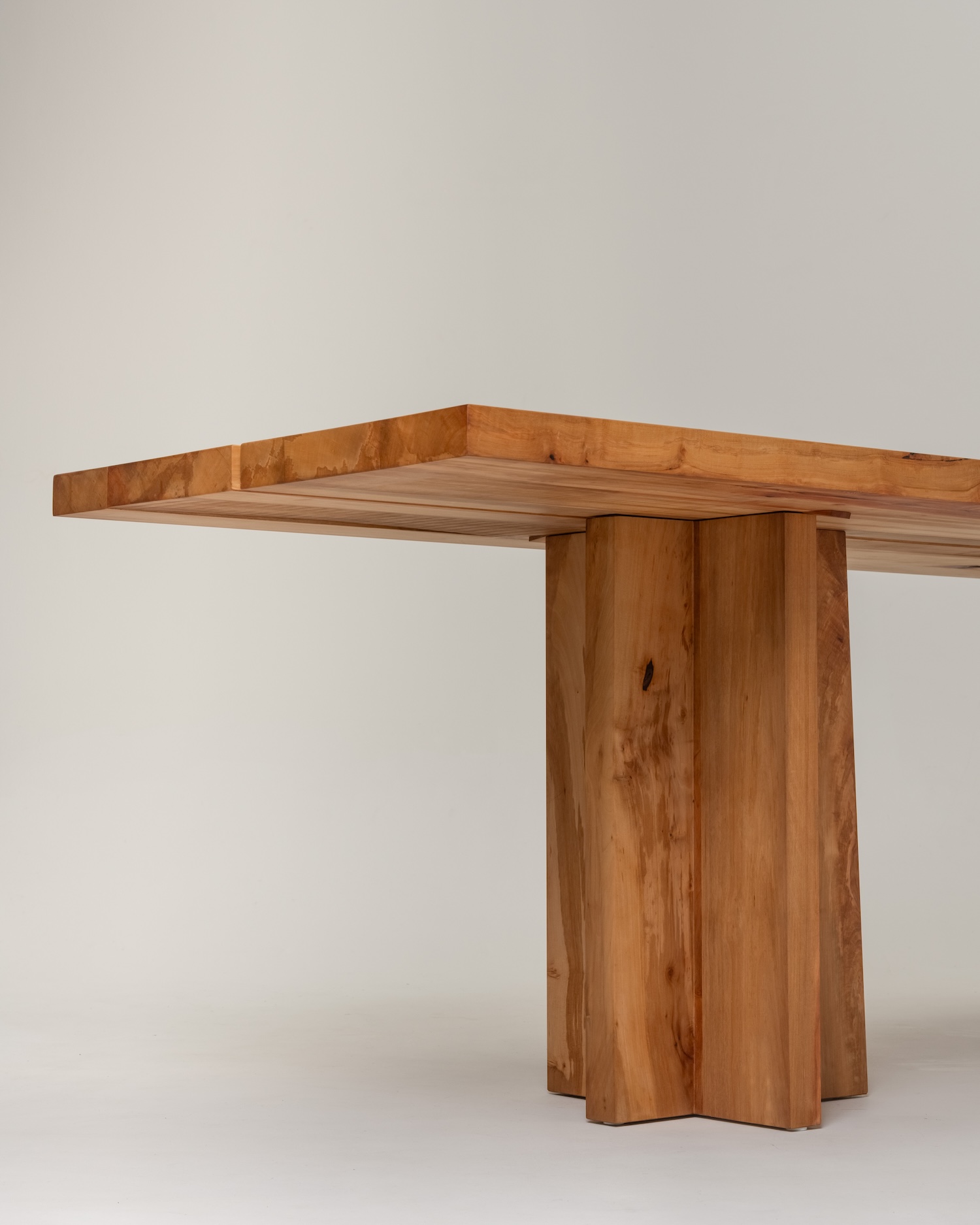
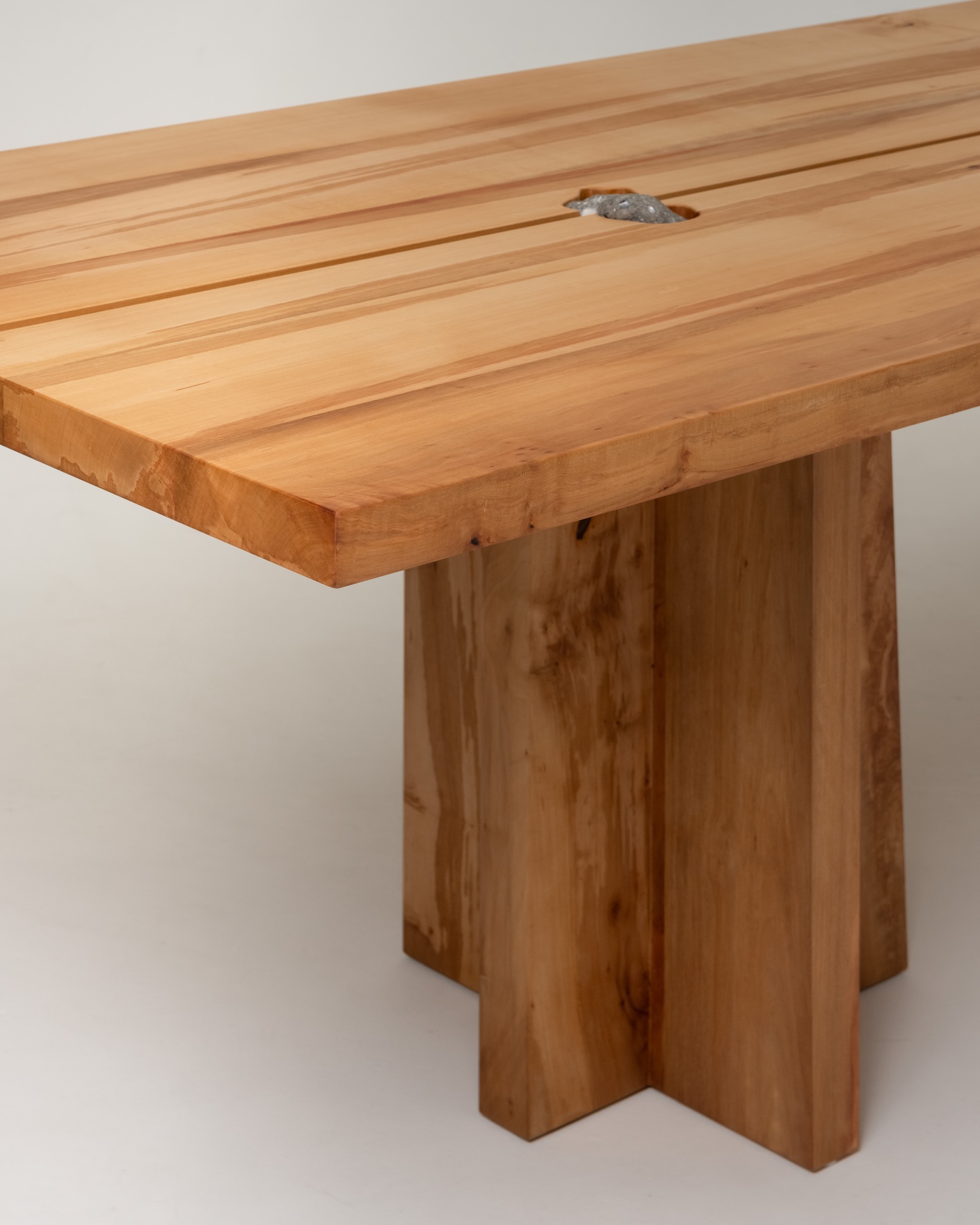
Sticks&Stones is a minimalist table created by France-based cabinet maker Dirk Meylaerts, in which the most familiar repair detail in woodworking is replaced by a stone picked up off a beach. The classic bow tie key, that hourglass of contrasting timber let into a crack to stop it travelling, has become so thoroughly aestheticized that it now functions mostly as a signature. Meylaerts removes the wood and puts a flint pebble in its place, and the substitution changes what the joint is for.
The butterfly key, chigiri in Japanese practice, exists because a board splits along the grain and the split wants to keep going. Setting a dovetailed insert across the fissure locks the two sides in shear. George Nakashima turned that necessity into a visual language, and two generations of studio furniture have followed. Here the logic is inverted. The gap is not a flaw that arrived after the fact but a designed interval between two separate tops, and the stone spanning it is doing the holding. What was a correction becomes a proposition.
Selection rather than fabrication carries the idea. The stones come from the shingle at Dieppe, on the Normandy coast, where flint eroded out of the chalk cliffs is worked by the sea into forms nobody drew. Finding a pebble already crossed in the shape of an X is a matter of patience on the beach, not hours at the bench, and that reversal of effort sits comfortably inside a practice built on rescuing overlooked material. Flint is also the hardest thing in the composition by a wide margin, roughly seven on the Mohs scale against timber that dents under a thumbnail, so the visual softness of a rounded pebble conceals the fact that it is the least yielding element in the object.
Pearwood makes the contrast legible. Its grain is fine, close, and almost featureless compared with the burls and figured slabs that dominate contemporary solid wood furniture, and that quietness is precisely why the stones register. Across 260 centimetres of length and 85 of width, a single continuous top would be fighting seasonal movement along its whole span. Two tops with a void between them acknowledge that wood keeps breathing after it leaves the workshop, and the interval absorbs what a rigid glued surface would have to resist.