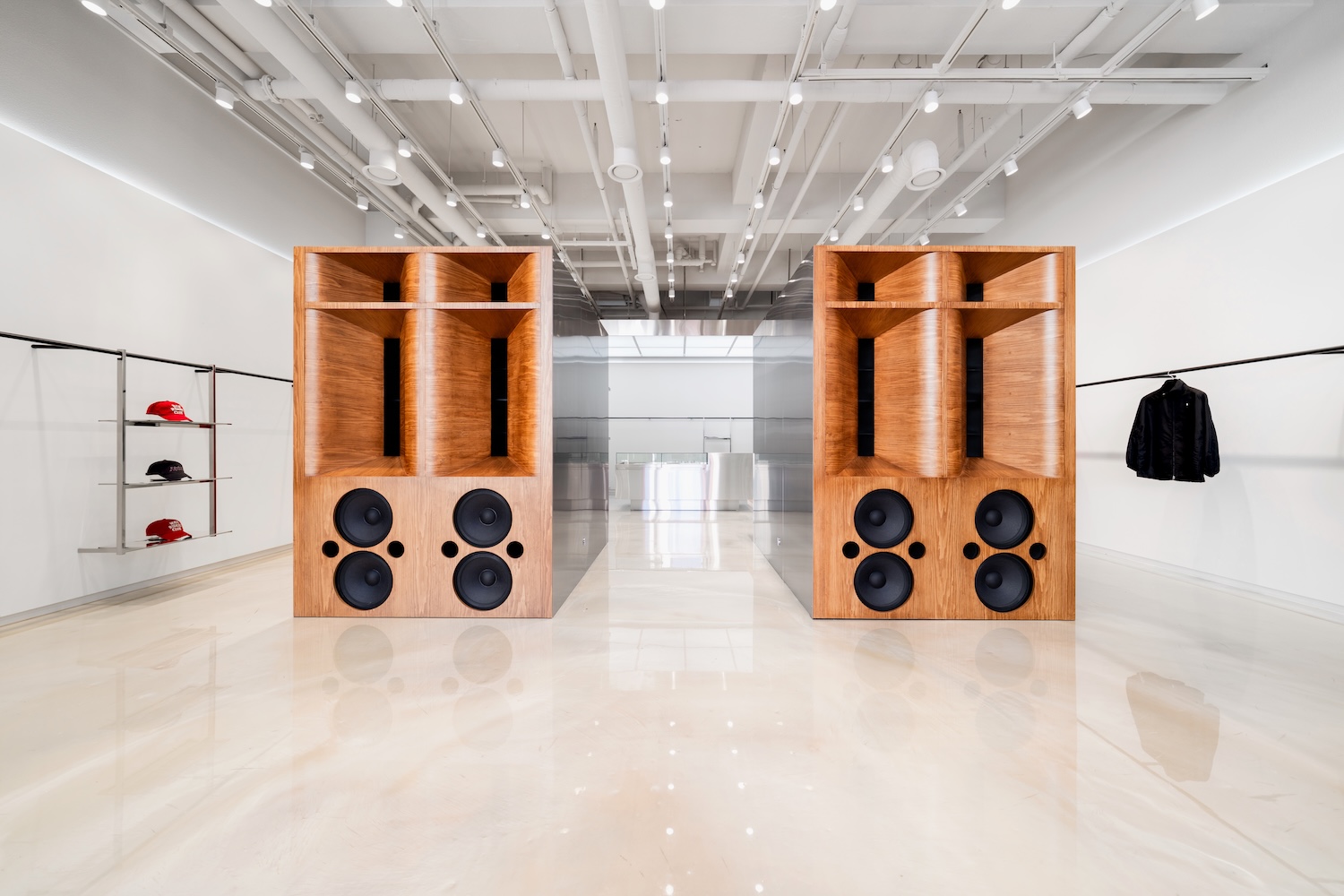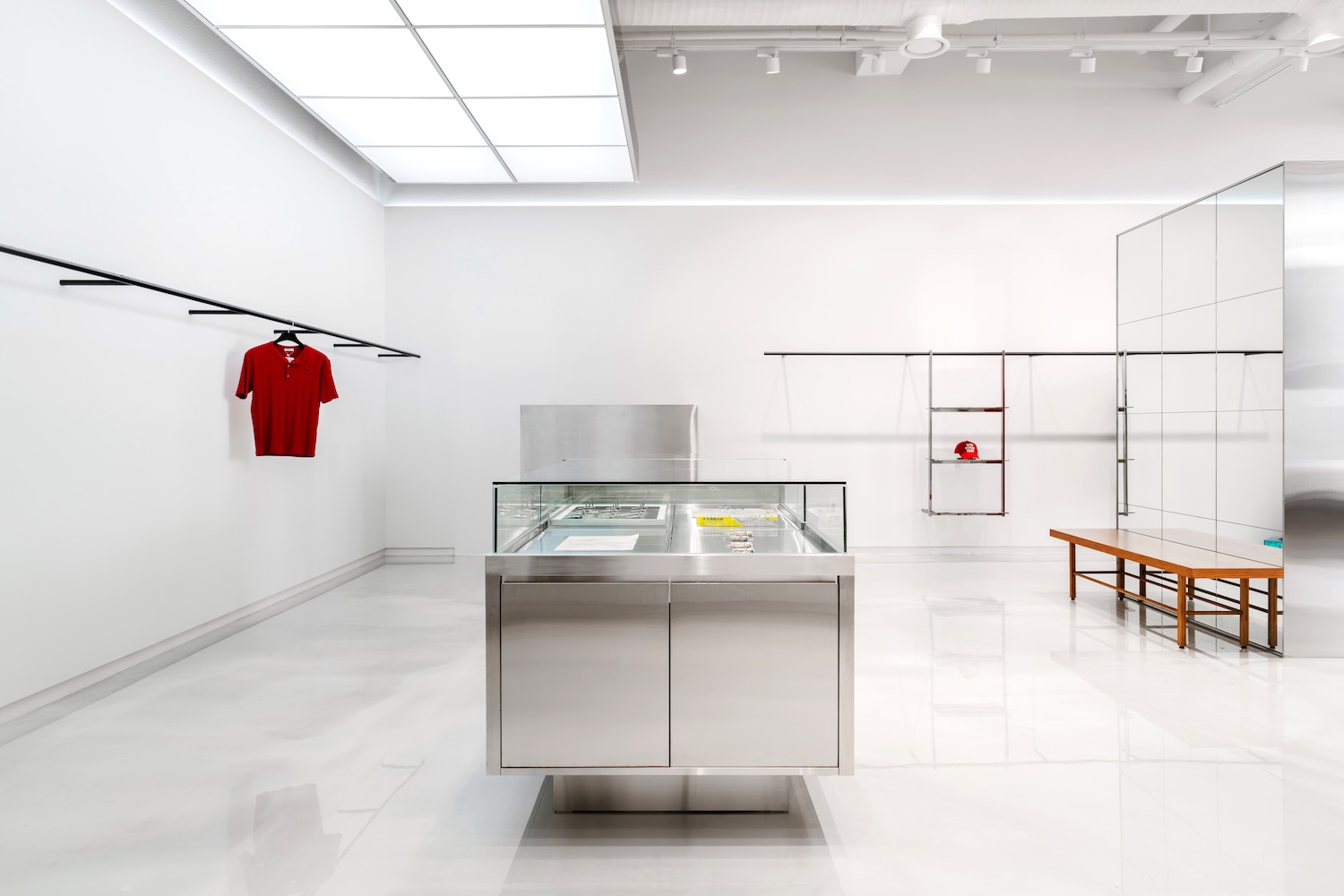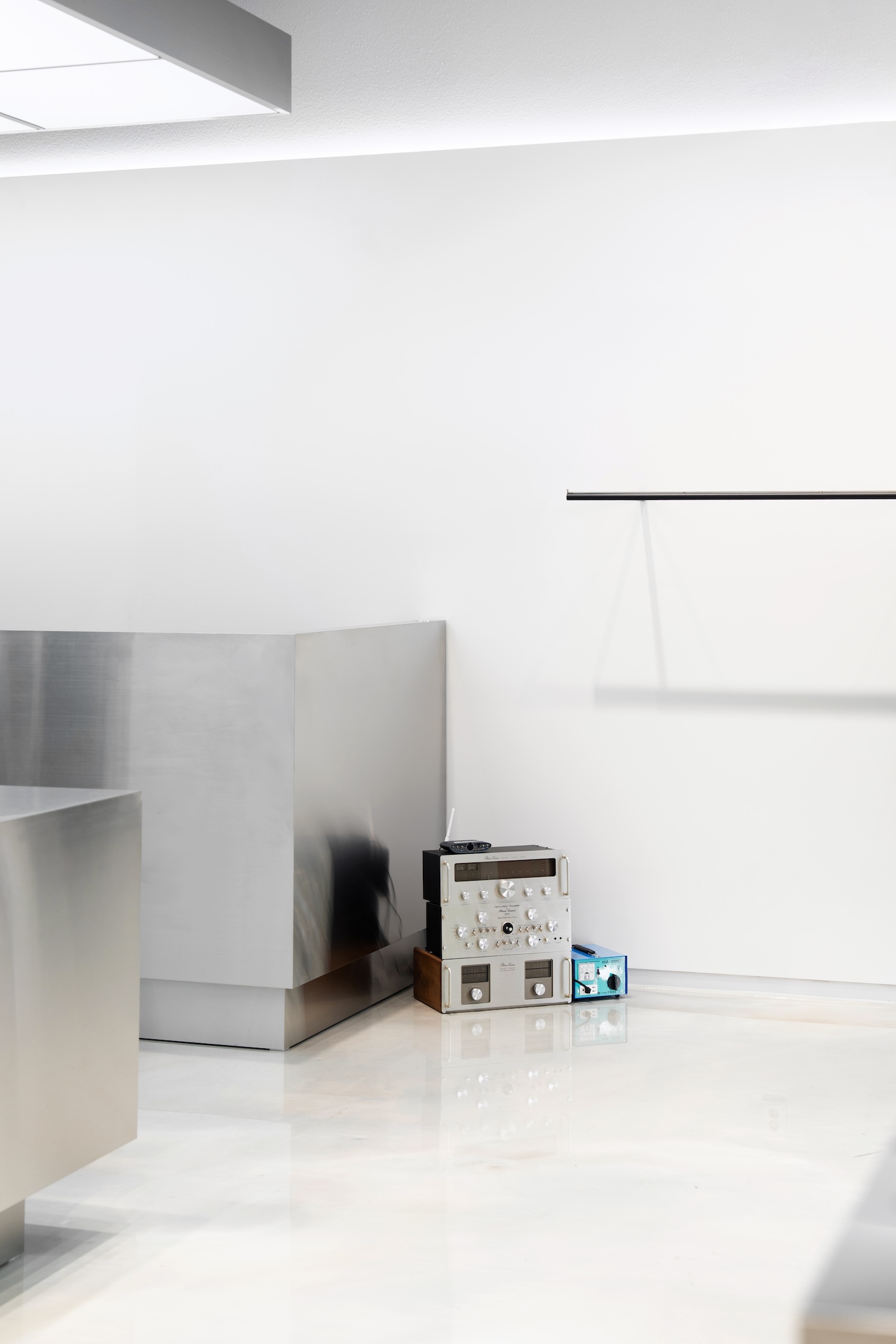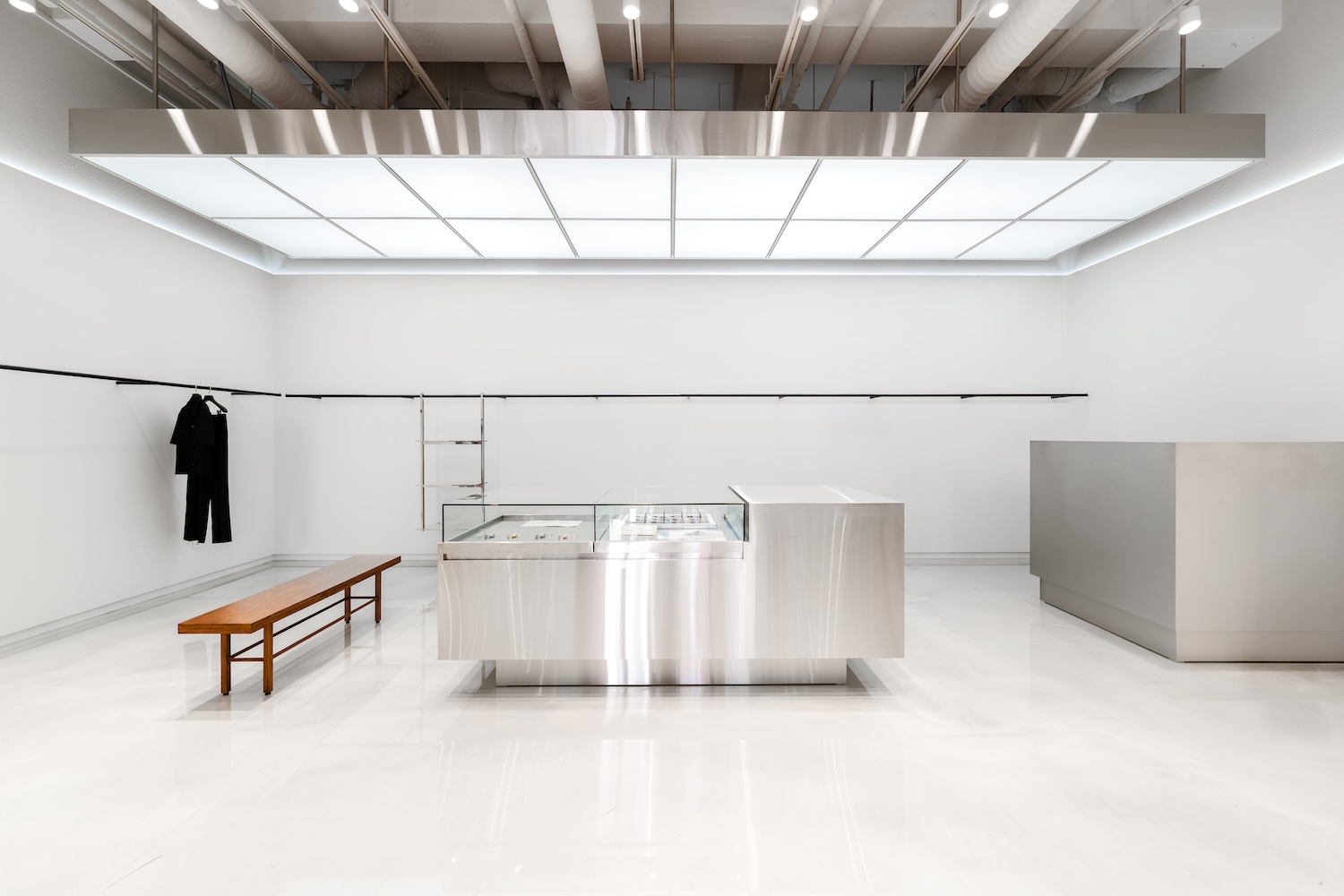
NOICE is a minimalist retail space located in Seoul, South Korea, designed by DISITTE. Spanning 1500 sqft on the ground floor of an Apgujeong building, the store places a pair of loudspeakers where fashion retail would typically position a cash wrap or central display table, and everything else falls into place around that choice. Garments are displayed along the perimeter walls while sound and the act of trying on occupy the core, with fitting rooms hidden directly behind the timber volume.
The speaker units are horn-loaded, and the detailing is precise rather than merely suggestive. Each cabinet houses four cone drivers in the lower bass section beneath an upper array of exponential horn flares, all constructed from oak-veneered panel stock with the flare profiles cut and joined rather than molded. The typology traces back to mid-century cinema and studio monitors such as the Altec Voice of the Theatre and the JBL Hartsfield—cabinets that moved from projection booths into Japanese jazz kissa in the 1970s and, more recently, into the listening bars of Euljiro and Hannam. Building them at furniture scale and standing them free in the room places the store within that lineage rather than merely referencing it.
Horn loading also resolves a problem created by the rest of the material palette. Luminous ceiling panels, a high-gloss poured floor, mirror-finished stainless islands, and glass showcases produce an acoustically hard room where a conventional direct-radiating system would blur across the reflective surfaces. Horns offer controlled directivity, projecting energy forward in a defined pattern and limiting what reaches the side walls and ceiling, so the sound remains legible in a space built almost entirely from reflectors.
The white volume continues a retail lineage that runs back to Gluckman Mayner’s Helmut Lang store on Greene Street in 1997 and John Pawson’s Calvin Klein on Madison Avenue two years earlier, both of which reduced fixturing to slender rails and treated the vitrine as a museum case. DISITTE pushes the approach further with mirror-polished steel islands whose surfaces distort rather than reflect cleanly, softening the volumes into something closer to mercury than metal. The generous spacing left around each garment does the real merchandising work, since a jacket hung alone on a run of black rail reads as an object under study.